

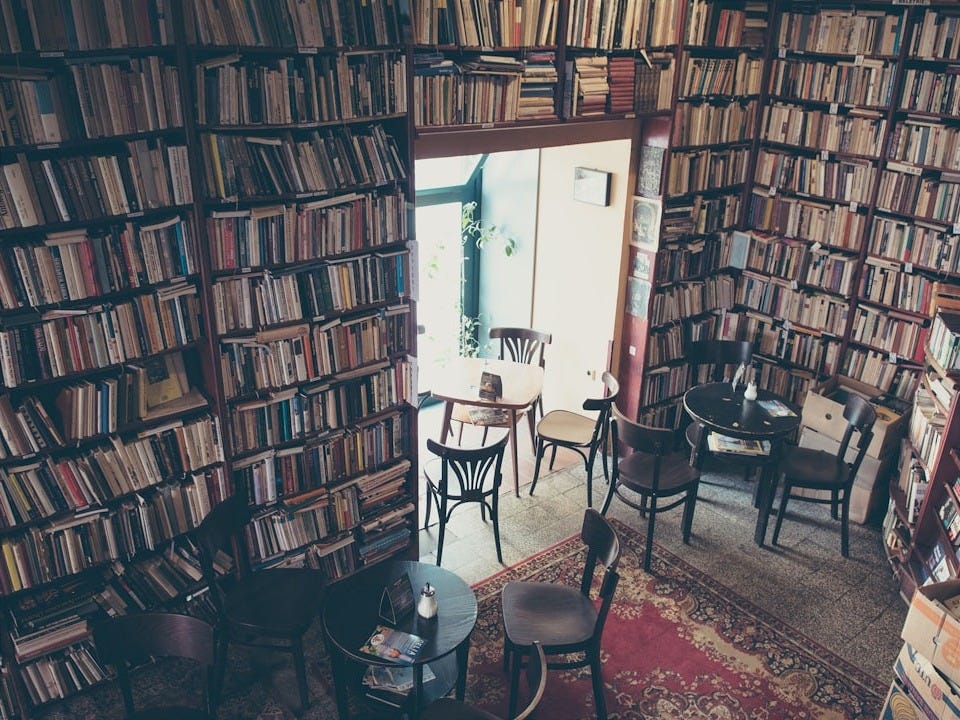
In the first year of this century, I was down and out in Prague, doing a bad impression of Orwell but without a book to show for it at the end. Skint and dislocated, I slept on a lilo in somebody’s hallway at night, and my shoes were so tattered that the laces had to be tied around the middle to keep the soles from coming off. I earned a few beer tokens teaching English, but nearly every other waking moment was spent drinking, reading and playing Scrabble like an obsessive with a fellow traveller. But reading most of all, and in dusty cafés – the sort that resembled a bohemian jumble sale of wonky armchairs and wobbly tables. This was a time before smartphones and American coffee chains. The internet was mainly for email at this point, and the devil was still workshopping social media. I didn’t realise at the time – nobody did – that these were the last days of a particular way of reading.
It was in Prague that I discovered the novel, or rather, the point of the novel – the joy of it. Before then, it had merely been a homework assignment, the thing I had to get through to pass an exam. I read whatever I could borrow, and there was plenty to go around: Kafka, obviously, but also Hesse, Vonnegut, and Dostoevsky. Flaubert was in there too, and, weirdly, John Grisham. These were simply the books that happened to be on other people’s bookshelves. I didn’t touch Dickens (I regret this) and had no interest in anything that took place in Victorian drawing rooms, although that has changed a bit since.
Oh, and I read the Guardian. And I mean I read every page, every op-ed with the youthful naivety of someone who had no clue about his own encyclopaedic ignorance. I even smoked a pipe. I must have been insufferable, but in my defence, I never made politics my identity, and that was how it was for all of us then – or at least among the people around me. We don’t live in that world anymore because the culture went through a metamorphosis of the kind that now makes that newspaper a punchline in at least three of my essays.
So I was surprised to find myself deep in the pages of the Guardian once again the other day, specifically its list of the 100 greatest novels of all time. My immediate thought was the same one I always have when I look at any list of novels, which is that I haven’t read nearly enough of them. My reading of fiction fell away in near-perfect correlation with the rise of the internet, though it’s truer to say I moved to nonfiction, which (I tell myself) tolerates interruption better and feels more useful.
My second thought was that I’m in no position to complain about the list – as many have – because I haven’t read most of the books on it, and there’s no such thing as a “correct” list in any case. This one was formed from a poll of 172 people, each of whom submitted their ten favourite novels, and even then, surely no two selections were the same. With that said, the top 100 struck me as probably fair and sensible, even predictable – although a few choices and omissions made me wince.
Which brings me to my third thought. It’s the one that troubles me most, and it’s not really about the list at all. It’s that I can no longer look at the top 100 of anything without my ideological Geiger counter switching on. Film reviews have the same effect. I’ve spent so many years thinking and writing about a certain kind of cultural capture that I’ve acquired a reflex. Now, before I’ve thought about whether a book choice is any good, a film review reliable or a podcast worth listening to, I’m already wondering who made it, and what they wanted me to think of them for making it.
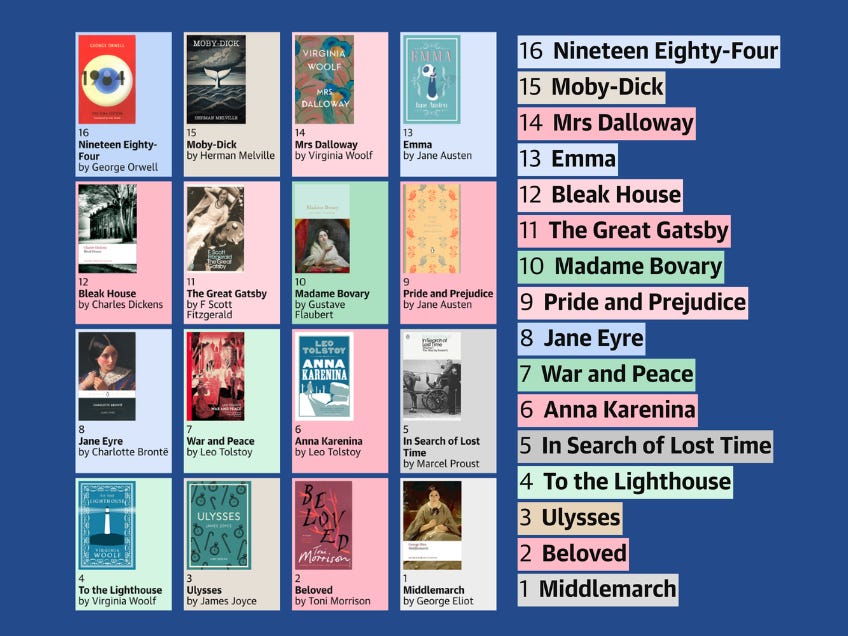
Take this Guardian book list, then. It’s full of names we would expect. Half a century ago, it wouldn’t have looked very different. Dickens is there and Austen, of course. Nobody would argue with the inclusion of Tolstoy and Proust. George Eliot’s Middlemarch was always going to be number one because it nearly always is. The Guardian calls it “an intricately patterned epic that explores work and marriage, ambition and creativity, selfishness and community spirit against a background of political, social and technological change.” Fifty Shades of Grey it is not.
Ulysses is there, of course. Only about seven people have read it all the way through, and it makes the Top 10 because nobody can explain why it shouldn’t be there. I haven’t read it but keep meaning to put it in the bathroom next to Gravity’s Rainbow – a bit of light reading for guests. Virginia Woolf gets five spots in the list. Five? I’d sooner fake my own death than read To the Lighthouse again (a homework assignment). Meanwhile, Fielding, Tolkien, Naipaul, Waugh and Steinbeck don’t get a mention. Who the hell put this list together, actually?
The trouble is that once the Geiger counter has been trained, it crackles at things that may not deserve suspicion at all. The cultural conversation around books and art this century has been corrosive in exactly this way – it produces the very cynicism it deplores, the cynicism I deplore but exemplify here. And running alongside it is the vying for status and positioning by cynics of another kind, who know exactly what’s going on and play the game ruthlessly.
It was very different just 25 years ago, before we mediated culture through our screens. Back in Prague, I was reading stories, but more than that, I was training my attention. The thrown-together cafés and borrowed books belonged to a world in which boredom still existed, and therefore, reading could still happen properly. Our minds weren’t broken into little pieces, mined for attention and monetised as a distraction. Nobody was optimising their cortisol count via wristbands or building a personal brand. And nobody was pausing halfway through The Trial to check whether Kafka was “utilising western hegemonic frameworks” or “advancing cisgender stereotypes”.
I’m not saying the culture was blissfully uncorrupted at the start of this century, of course not. Canons were always shaped by fashion, class, and resentment. Politics and culture are inseparable, and the idea that a book list could ever be objective is silly. The difference is, at least for me, that I could still pick up a novel without first asking what it was about, why somebody recommended it to me, or what the author thinks about Palestine or capitalism. I am no longer sure I can.
If there’s a solution, it’s not in the noise that surrounds books and lists, but in the books themselves. Which brings me to a passage I came across recently by the French novelist Michel Houellebecq, who didn’t make the Guardian’s hundred, but whose cynical and misanthropic narrator in Submission is an unlikely source in modern fiction for a defence of the novel:
“Only literature can give you access to a spirit from beyond the grave – a more direct, more complete, deeper access than you’d have in conversation with a friend. Even in our deepest, most lasting friendships, we never speak as openly as when we face a blank page and address a reader we do not know. The beauty of an author’s style, the music of his sentences have their importance in literature, of course; the depth of an author’s reflections, the originality of his thought certainly can’t be overlooked; but an author is above all a human being, present in his books…”
That is what all the cultural babble obscures. A novel isn’t a positioning statement or a vehicle for ideological propaganda. At least, the ones that last aren’t, and the same is true for poetry or any art form. Nobody reads The Odyssey and comes away saying they agreed or disagreed with it. They might say they loved it or found it boring or thought the translation was ideological – an exhausting conversation for a different essay. But what makes literature last is the story itself, the human presence on the other side of it. The tragedy with so much cultural discourse today is that it trains us to meet art with suspicion before it’s had a chance to speak. Before a film can make us laugh or a book enlarge our view of the world, we ask which side it is on.
The trick is to ignore as much of the noise as possible and leave the screen at home. Find a quiet café, simply read the book in front of you, and judge it on its own merits.
Not Sally Rooney, though. She’s a Marxist.

What do you think of the Guardian’s Top 100 list? What books and authors do you love? What are you reading at the moment? Join the discussion.
You might also like:


This is a great essay and so true. I find myself at 76 returning to the classics to find in them what I missed because I was too young when I read them or skipped reading them in the past. In line with your thoughts, I’m very suspicious of current “best sellers “ or “recommended “new publications because they are often/always woke themes and often these blatantly pushed without any insight, thought provocation or even interesting writing style. Ideology reigns. And, prize winning is similarly skewed. However, my own resistance occasionally bites me. Someone I trust recommended Trust (pun intended) by Hernan Diaz, a Pulitzer Prize winner….which heighten my suspicion of its messages before I cracked it open. But, I gave it a try and I loved it. Interesting structure. Great writing. Relatable to me in some stunning ways. I read it in less than three days which is unusual for me, given the demand in my life and my old attention span (age, social media and iPhone degraded)! But, reading the great classics now seems a breath of fresh mountain air.
You've captured the essence of something for me that I couldn't name. It used to be that reading a novel was a singular act - you sat with the material in front of you. You didn't run it through a filter of binaries and moral absoluteism. You simply read it and experienced it in a way that was relevant to the reader. I really, really miss those more innocent days of reading for its own sake. I hate now that so much writing is about "important messaging".