


_poster.jpg)
The last James Bond movie was five years ago. I remember nothing about it except that, in a first for 007, he dies at the end. This was the best part of the film because it signalled that it was over and I could drag my CGI-battered senses to the exit sign, which had been the most interesting visual in the cinema up to that point.
There was a lot of messaging in the film, of course (masculinity is bad, etc), but as I say, I don’t recall the details; nobody does. The next instalment, when it arrives, will likely ignite the usual media buzz, the sort that accompanies the England football team going into the World Cup before getting knocked out by Uzbekistan on penalties in the quarters. These two events, coming every few years, have tested the patience of an exhausted people who just want a few wins to punctuate the decades-long managed decline of their country – something that says we can still pull our weight, make a splash, hit the target.
I doubt the next Bond will deliver on that promise. There’s been speculation about a woman in the lead role, but the more likely move will be to make the next Bond black. Idris Elba’s name has popped up a few times. He would be a fine choice because he would fit the expectation that actually counts. He could inhabit that masculine, brutal, slightly cruel character of the Fleming novels if they let him. Because Bond is resolutely not a feminist. He’s not checking in with Moneypenny about her boundaries or filling out MI6’s inclusivity survey. He’s an assassin. True, Fleming imagined him as a Scots-Swiss product of the British establishment, but the franchise stopped treating that as binding decades ago. This is an action movie, first and foremost, with a recognisable character at its centre. The colour of his skin (it seems to me) is irrelevant.
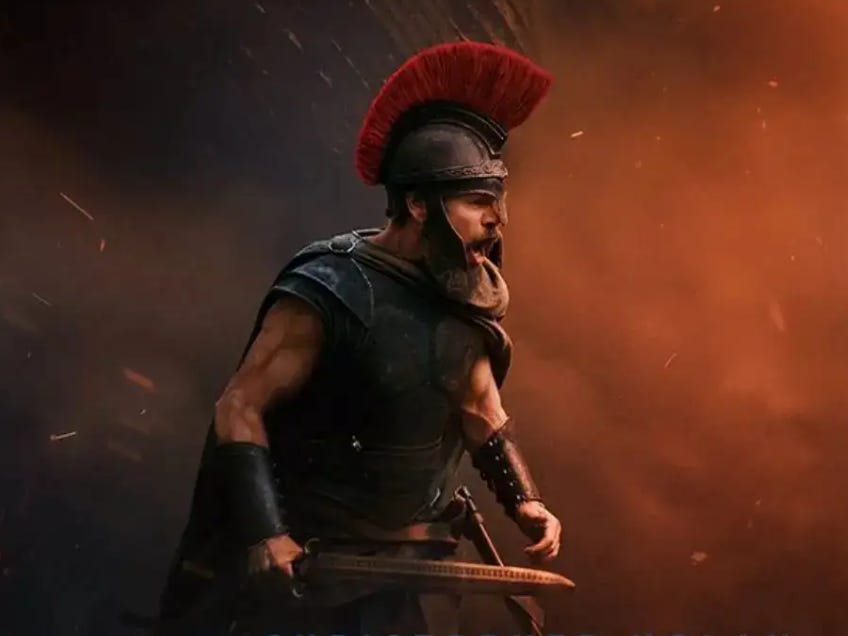
I’m not sure I would say the same about the casting of Helen of Troy. We recently learned that Lupita Nyong’o will take the role in Christopher Nolan’s Odyssey. The film, which opens in July, is Nolan’s most expensive and ambitious to date. Like Bond, Helen is a character in a work of fiction. But unlike Bond (a franchise character invented in 1953), she’s foundational in a 3,000-year-old text of Western civilisation. Hers is the face that launched a thousand ships. Homer’s stories are what the Ancient Greeks told themselves about who they were, and Helen of Troy is a pivotal figure in that account. Homer describes her as “leukōlenos” – white-armed.
To cast a black actress in the role is to make a statement, and Nolan knows it. The issue isn’t whether Nyong’o is beautiful (I’ve no argument there), nor that she’s black per se. It's that we're being spoonfed an anachronism that shoehorns modern sensibilities into the ancient world. Bond is a character in a franchise. Helen belongs to the Western canon. Casting them isn't the same kind of choice.
If you think it’s irrelevant who plays Helen, then imagine a film adaptation of the Bhagavad Gita – the most sacred text of Hinduism – starring Ben Affleck as Lord Krishna. Or a biopic of Confucius with Tom Cruise in the title role. Or Lady Gaga in the musical version. No Hollywood studio would dream of making these casting decisions today, so why does the same logic operate in reverse for the Odyssey?
Nolan might yet surprise us. He’s made a dozen films, and none that I remember were interested in identity politics, so maybe he’ll leave ideology at the door for his latest as well. But the early signs are not encouraging. There’s already a rumour that Elliot Page will take the role of Achilles, armoured with pronouns and a six-pack. Then there’s rapper Travis Scott. Nolan recently told Time magazine that Scott was cast because the Odyssey was “oral poetry, which is analogous to rap” – the reasoning of a man who has just discovered both.
Even if all these speculations are just to create noise (as I’m doing here), there’s no escaping the broader trend. Hollywood, the BBC, and every other production company keep casting people in roles in ways that run counter to audience expectations. It’s designed to elicit a reaction that can then be filed as evidence of the racism or transphobia it sets itself up to combat. This is a feedback loop that has played on auto for years and shows no signs of wearing itself out. But what the cultural establishment fails to understand is that the pushback is not, for the most part, a protest about historical accuracy and rarely, if ever, actually racist in any literal sense. The actual complaint is more mundane.
To continue reading this article and support my work, you can upgrade here. You’ll get access to the full archive – currently around 40 essays – and the comments section.