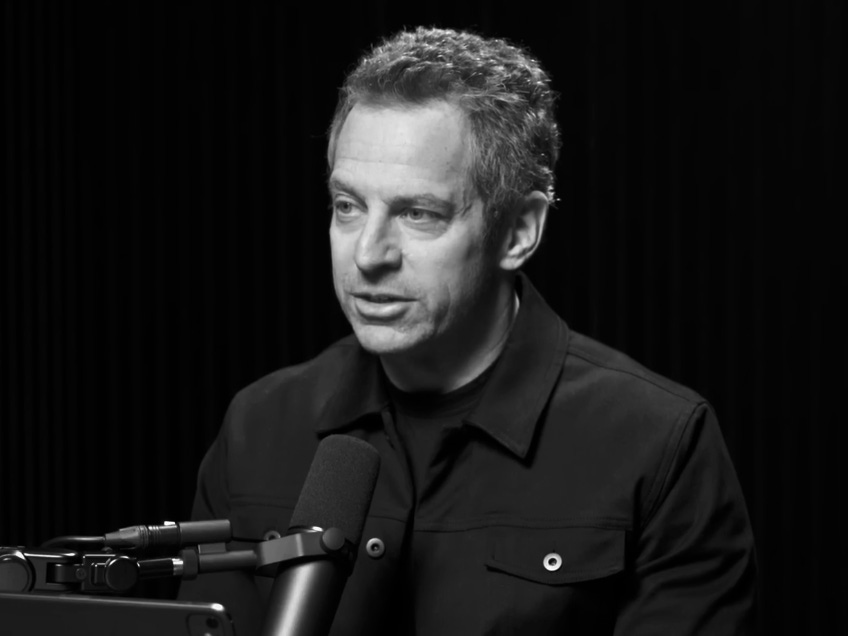
The Moral Clarity of Sam Harris
Why the man who drives everyone nuts is maybe the one to trust.
The title of this essay will have already divided some readers before I get to the first argument. For many, the words “Sam Harris” and “moral clarity” in the same line are uncontroversial, even obvious. Harris, they tell you, has spent more than two decades saying unfashionable things plainly, and often more lucidly than any other public intellectual alive, especially on religion and the moral idiocies of our age. But to some on the left, he is the “Islamophobe” who wants to profile brown people at airports. To some on the right, he is the man who can dissect jihadism from outer space but has a meltdown the moment populism enters the room. Even his own large and devoted audience cannot quite fit him into an ideological box, and often finds him maddening for reasons of its own. This is someone who’s clearer than most of his critics, more exasperating than many of his admirers care to admit, and somehow charges an incredible $25 a month on Substack for the privilege, which many thousands are apparently willing to pay.
I stumbled on Harris’s first book, The End of Faith, the month after it was published in 2004. I read it once, in one sitting, then immediately read it again. I was so impressed that I handed copies to friends, one of whom skimmed the first chapter before throwing it disdainfully on the floor and declaring it racist. That category error – mistaking criticism of Islam for hatred of Muslims – would alternately bore and infuriate the rest of us for the next two decades, right up to the present day, when the British state still worries more about “Islamophobia” than protecting its own children. Harris has been as useful a guide to that moral confusion as anyone, and he brings the same clarity to the Israel-Palestine conflict, which, in hindsight, is where all this was always heading. I’ll come back to that.
First, let’s briefly map the path by which he became one of the leading public intellectuals of our time.
Harris emerged as one of the “Four Horsemen” of the new atheist movement that followed 9/11, alongside Christopher Hitchens, Richard Dawkins and Daniel Dennett. That chapter feels like something from another age – it was another age – when rationalism was in vogue and social media was in its infancy. Nobody talks about atheism any more, partly because a new religion stepped into the arena and got everyone arguing about gender and race instead.
Later, Harris became associated with the “intellectual dark web”, a loose collection of heterodox thinkers and academics arguing against the new orthodoxy, including Jordan Peterson, Ben Shapiro, Eric Weinstein (who coined the phrase as a joke) and others. That lasted about five minutes, and by the time Covid came along, nobody could agree what they were for or against.
His primary concern throughout these years has been the moral significance of belief – that ideas matter, and that bad ones matter in ways the West would rather not think about. That was essentially the argument in his first book, and it runs through everything he’s written and talked about since, including Islam, Trump, Covid and Israel. Islam most of all, though.
Long before progressive ideology had trained polite society to treat moral clarity as indecent, Harris understood that liberalism cannot survive without the ability to criticise dogma. The left had been explaining away extremism since Salman Rushdie went into hiding for writing a novel, but 9/11 ushered in a remarkable new settlement on the part of the cultural and political establishment. Islam, we were told, was somehow deserving of special exemptions from scrutiny. We learned that criticism of Islam as a set of ideas was equivalent to hatred of Muslims.
To see that moral confusion play out, we can turn to a fascinating cultural artefact: the exchange between Ben Affleck and Harris on Real Time with Bill Maher.
Affleck, standing in for polite society everywhere, simply cannot compute the moral logic Harris is offering. All he’s got is indignation. All he hears is bigotry because he’s soaked up the relentless messaging that honest discussion of political Islam is somehow a form of racism, even though Islam is obviously not a race but a set of ideas. “It’s gross, it’s racist”, says Affleck, echoing a sentiment an entire class has marinated in for a quarter of a century. Affleck isn’t stupid, by the way, nor do I think he’s dishonest. He’s just confused somewhere between becoming Batman and performing the duties of a conscientious Hollywood liberal. Like so many well-intentioned and busy people, he’s absorbed something from the surrounding noise, the way some people pick up an accent. The real dishonesty belongs to the people who feed it to him – the ones who know it’s a category error and reach for it anyway, because admitting it would lose them the argument. Such has been the political culture of our time, with truth a secondary consideration to the demands of the tribe.
Which brings us to Trump, that perfect distillation of everything Harris loathes. Trump, I would agree, is a grotesque figure in many ways: mendacious, egotistical, and vulgar. In 2016, Harris painted a typically vivid image of the man:
“Blow up a balloon without tying off the end, and hold it up high, and then release and watch it fly chaotically around the room. That’s Trump’s mind. In my view that’s what we’d be doing with the country if we put him in charge. Just hitching our future to a totally chaotic system.”
The image was funny because it was true, and the first presidential term bore it out, helped by a media class that went off the rails and still doesn't understand the strange lifeform that is Donald Trump. But Harris did get somewhat obsessive on the subject – enough that even sympathetic listeners started tuning out whenever Trump came up, and his critics claimed he had full-on "Trump Derangement Syndrome". Yet to me, it's always been obvious that Trump is simply a bullshitter in the sense Frankfurt discussed in his famous essay. Unlike a liar who knows the truth and intentionally hides it, a bullshitter is largely indifferent to whether what he says is true or false. Trump doesn't care about the facts; he cares about making the deal. Next to that, you have institutional lying that looks respectable on the surface, speaks in whole sentences and talks about empathy and "saving our democracy". This is lying in the proper sense – deliberate, fluent and ultimately more deceptive.
The Clintons and Obamas of the world seem more “presidential” on the surface, but decorum is not the same as honesty. The people who lied about borders, sex, grooming gangs and political Islam do not become less dishonest because they wear appropriate expressions of concern and speak in managerial clichés. Trump may deal in obvious lies and pointless insults, but on certain basic realities, he grasps the truth that matters: that countries need borders, that men are not women, and that radical Islam is a serious threat. One doesn’t have to wear a MAGA hat or drink “liberal tears” from a mug with his face on it to see that these are statements of common sense that only the hypereducated class could fail to recognise.
Then came Covid. Harris was right that a global pandemic is not the moment to outsource your reasoning to memes and gym bros. Scientific expertise matters – of course it does. The problem is that experts are just as vulnerable to incentives, panic, groupthink, and self-protection as anyone else. The warning signs came early enough with the extraordinary and universal dismissal of an entirely plausible lab-leak hypothesis. That’s what set off the alarm for me, and I expected much greater protest from Harris on that point. Instead, his anxiety about catching the thing was so palpable you half-imagined him recording the podcast in a Hazmat suit. He was hardly alone, though. A lot of sensible people spent 2020 wiping down bananas and failing to notice the sinister “show me your papers” turn we’d made as a society – mainly because they were the ones demanding it.
The terrible irony, of course, was that reckless institutional overreach and a compliant media produced exactly the collapse in trust Harris feared. The moral coercion and dismissal of dissenting voices created an army of conspiracy theorists, among them formerly sensible people like evolutionary biologist Bret Weinstein, now inspecting mushrooms for signs of CIA involvement. We’re living with the results today, in which a large part of society will instinctively reject anything that comes from institutions on the grounds that they lie. This is how we get people like Candace Owens building a business on telling the credulous how much smarter they are than the rest of us. And yet there was an honest and credible version of dissent from the start. Bhattacharya, Kulldorff and Gupta, highly qualified epidemiologists dismissed as “fringe” voices, were making arguments that later looked far more reasonable than the institutional consensus allowed. Where was Harris on them? Firmly with Francis Collins, who dismissed the Great Barrington Declaration as “dangerous” and “not mainstream science”. We could have used a bit of Harris’s rational scepticism, but it never came – not because he’d stopped thinking, but because he’d handed the thinking to people he trusted to do it well. Harris faced severe blowback from his own audience over his compliance with government narratives, but I never once doubted his intellectual honesty. He’s since spoken about the severe damage public health institutions did to their own credibility through confusing, politically motivated, or scientifically invalid statements.
It’s possible to be wrong in good faith, and it’s easy for me to sit here, in hindsight, and call out the errors. The truth is, everyone was wrong about something during Covid, and the whole episode looks more deranged now than it did then, if that’s even possible. What Covid exposed is how difficult honesty becomes when the people you distrust happen to be right about something, and when your trust in institutions starts doing some of your thinking for you. But moral clarity and intellectual honesty are not the same as always being right. They’re about refusing to lie or flatter your audience, even when the incentives to do so are strong, and refusing to protect a position once the evidence has turned against it.
Harris is brilliant on the topic of lying, and wrote a book by the same name – a short work that takes only a couple of hours but is probably the best thing you will ever read on the subject. Harris takes honesty seriously, not as a point of etiquette, but as a foundational principle of moral life. And not just the big lies or the useful ones, but also the white lies that lubricate social life and pass for kindness.
“When we presume to lie for the benefit of others, we have decided that we are the best judges of how much they should understand about their own lives—about how they appear, their reputations, or their prospects in the world. This is an extraordinary stance to adopt toward other human beings, and it requires justification. Unless someone is suicidal or otherwise on the brink, deciding how much he should know about himself seems the quintessence of arrogance. What attitude could be more disrespectful of those we care about?”
The point is that lying is ultimately a corruption of reality between people, and when we make a habit of it, it corrupts something larger than all of us: truth itself.
Which brings me finally to Israel and why I’m writing this piece today. In a recent essay, Harris wrote about an issue that has convulsed the culture in a way that has brought together every terrible idea of the modern era: moral relativism, anti-Western masochism, Jew-hatred, TikTok geopolitics, luxury-belief activism, and endless victimism.
Against this noise, Harris presents a simple test. What would each side in the Israel-Palestine conflict do with absolute power? If Israel laid down its weapons, what would happen to the Jews? If Hamas and its supporters laid down their arms, what would happen to the Palestinians?
It’s a clarifying question, which is exactly why it attracts a particular kind of clever objection. Harris’s article is about why he won’t debate critics of Israel, to which the writer Andrew Sullivan has responded:
“If you choose not to debate anything Israel ever does, you are effectively refusing to debate decades of ethnic cleansing, settlements and pogroms on the West Bank, the mass murder of 30,000 women and children in Gaza…”
Mass murder? That “30,000” is a Hamas-reported statistic, by the way. Even taken at face value, it includes Hamas combatants, not just the women and children he claims. So we’re already on shaky ground, but he continues:
“The underlying argument is that everything Israel does is always entirely justified by the nature of its enemies. The whataboutism is total. The suspension of all moral reasoning is necessary to wage a war on Islamist fundamentalism… there is literally no crime that Israel could commit that would allow some Israel supporters to reassess their total support. There really isn’t.”
Sullivan has taken a question about intentions – what each side would do with total power – and twisted it into a new claim: that whatever Israel does is “always entirely justified”. Those aren’t the same things, and asking what might happen when one side lays down its arms is not the suspension of moral reasoning – it is moral reasoning. You can condemn Israel’s settlements in the West Bank, refuse them any justification whatsoever, and still distinguish a democratic state from a movement that seeks to eliminate it. Sullivan obscures the point because an intellectually honest response would force him to concede the distinction Harris is making. It’s the sort of move critics of Israel make all the time. No wonder Harris won’t debate them.
The fact is, we know exactly what Hamas and its enablers would do because they’ve been telling us since their founding charter of 1988. Israel, on the other hand, contains within it the possibility of coexistence because it has already subscribed to the liberal project. The population of Israel is roughly 18% Muslim (in Britain, it’s roughly 6.5%), and some of those occupy civic positions; some are even judges. It’s not perfect, but it’s held to a standard demanded of no other country, a point completely lost on the critics who hold it there.
The evils of October 7 were so painfully, desperately obvious to me that I just assumed all rational, decent people would readily accept what happened, would look at the footage Hamas gleefully produced for us, and show immediate and unwavering concern for the people of Israel. When those things didn’t happen, or came with terms and conditions, I couldn’t quite believe it. And yet of course this is exactly how it would turn out. The same category error my friend made in 2004, throwing the book on the floor, is the one that has now metastasised into a global movement that cannot tell the difference between a state defending itself and a death cult. Twenty-five years of watching the confusion compound, aided by victimism and social media tribalism, and here it is at full stretch, the horseshoe closing on the one enemy it always finds: the Jews. Harris asks:
“Why does antisemitism matter? Well, for the Jews, it’s obvious why it matters, but why should it matter to everyone else? It matters because when you look at what antisemites also hate, you find they hate everything that makes culturally rich, diverse, open societies possible. Real antisemites bring with them more than just their hatred of Jews: they bring censorship, political repression, conspiracy thinking, and the politics of dehumanization and scapegoating. So decrying antisemitism is not an act of special pleading. It is a defense of the moral and institutional architecture that free societies require.”
In the end, this is why Sam Harris matters. He’s maddening at times and occasionally gets stuck on repeat. But he’s not a performer. He’s the antithesis of those commentators for whom the issues of our day are just raw material for the attention economy – the Tucker Carlsons and Hasan Pikers of the new media landscape – rather than questions of genuine moral seriousness. He never surrenders to his audience, and anyone who’s been listening to him these last two decades, as I have, knows he would adjust his position the moment the evidence pointed him in a different direction. He has that rarest of traits in public life, the one no price can be put on: a commitment to intellectual honesty.
You might also like:


Hitler used anti-Semitism to good effect but he hated Poles just as much. The Nazis killed 6 million Jews but their plan was to kill 30 to 60 million Slavs and to wipe Poland off the map. They actually killed 3 million Polish Jews and also 3 million non Jewish Poles. It is never about the Jews, because those who hate Jews will always turn to attack others as well. This used to be understood on the Left, but because of refusal to see Islam as it is, not any more.
Very well written, Frederick. I have read Harris' books and I much admire him.