Somewhere in Britain at this moment, a man and his young family are living a life in secret. They go about their lives under false identities in an unfamiliar town or city, making new acquaintances, but never revealing who they are or what brought them there.
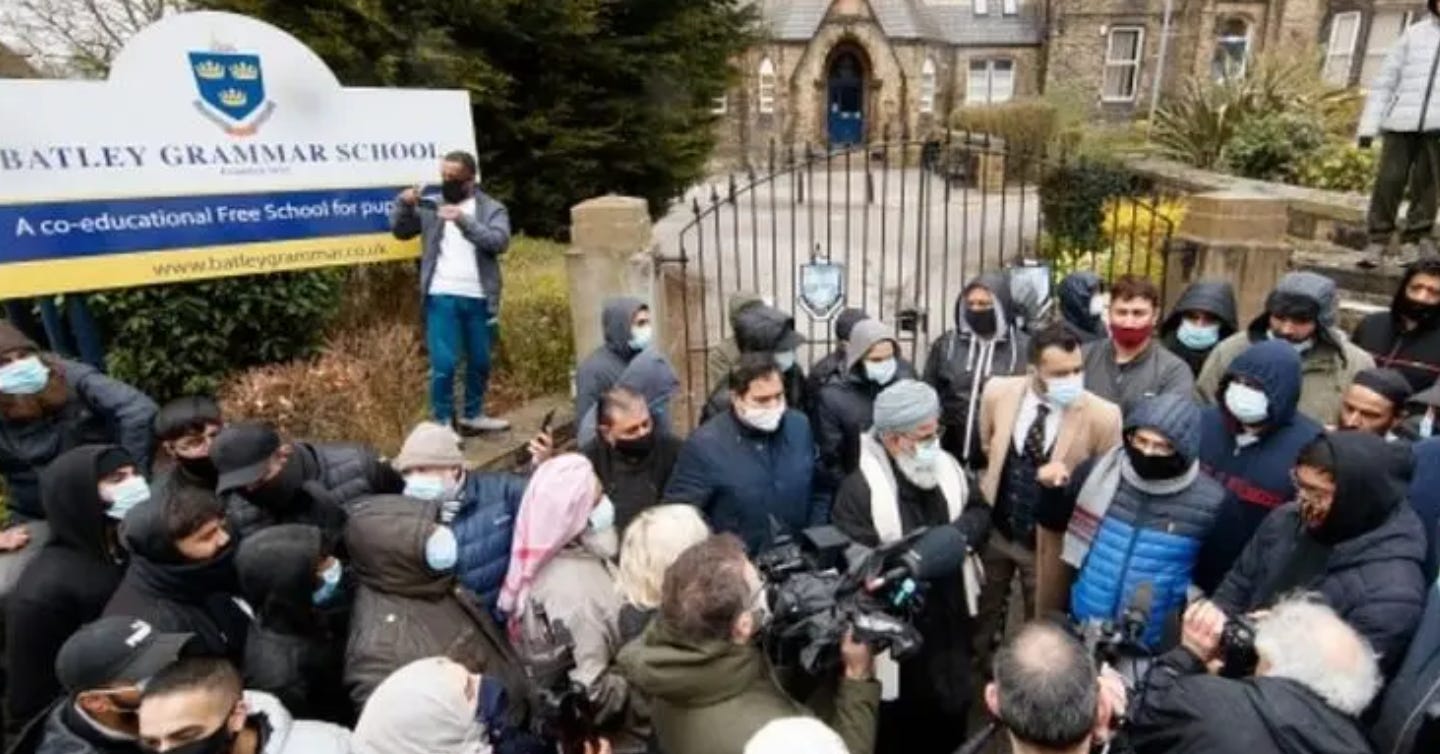
The Batley Grammar School teacher, as we know him today, remains in hiding. No one has been arrested for threatening him, his career is over, and he will spend the rest of his life knowing that he’s the target of Islamist rage.
I don’t know what was in his lesson plan, except that it was about blasphemy and free expression. It wasn’t the first lesson he’d given on the topic, and it followed the approved national curriculum. Charlie Hebdo was in there somewhere. If I’d been teaching the lesson, I might have asked the students what motivates some among us to murder twelve people for publishing a cartoon. Perhaps he did the same.
What we know for certain is that the lesson led to protests outside the school gates, along with denunciations from “community leaders” and the sort of threats that would make anyone want to stay out of sight.
This all happened exactly five years ago and made two messages clear to anyone paying attention. First, intimidation works. Second, those with the power to do something about it will not merely look away; they’ll recast the intimidation as a legitimate grievance.
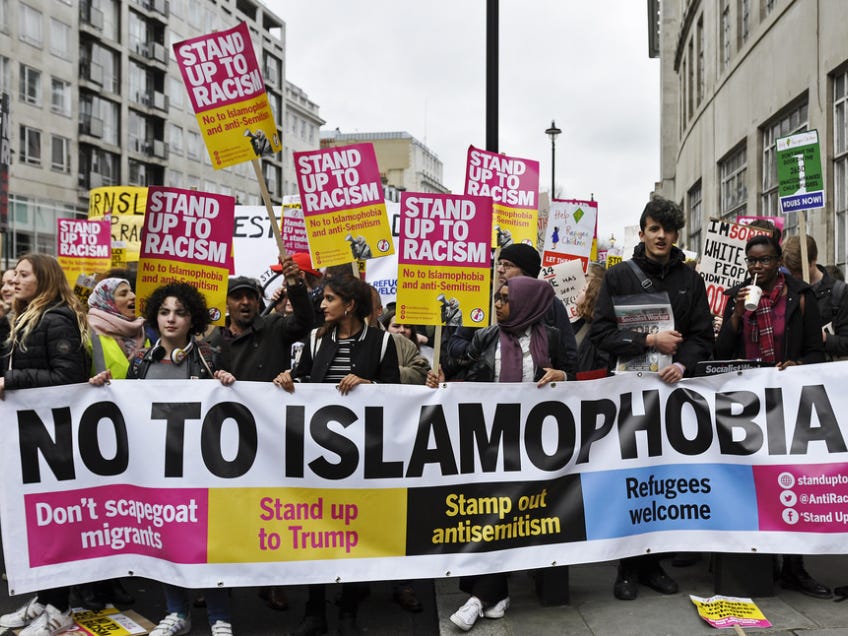
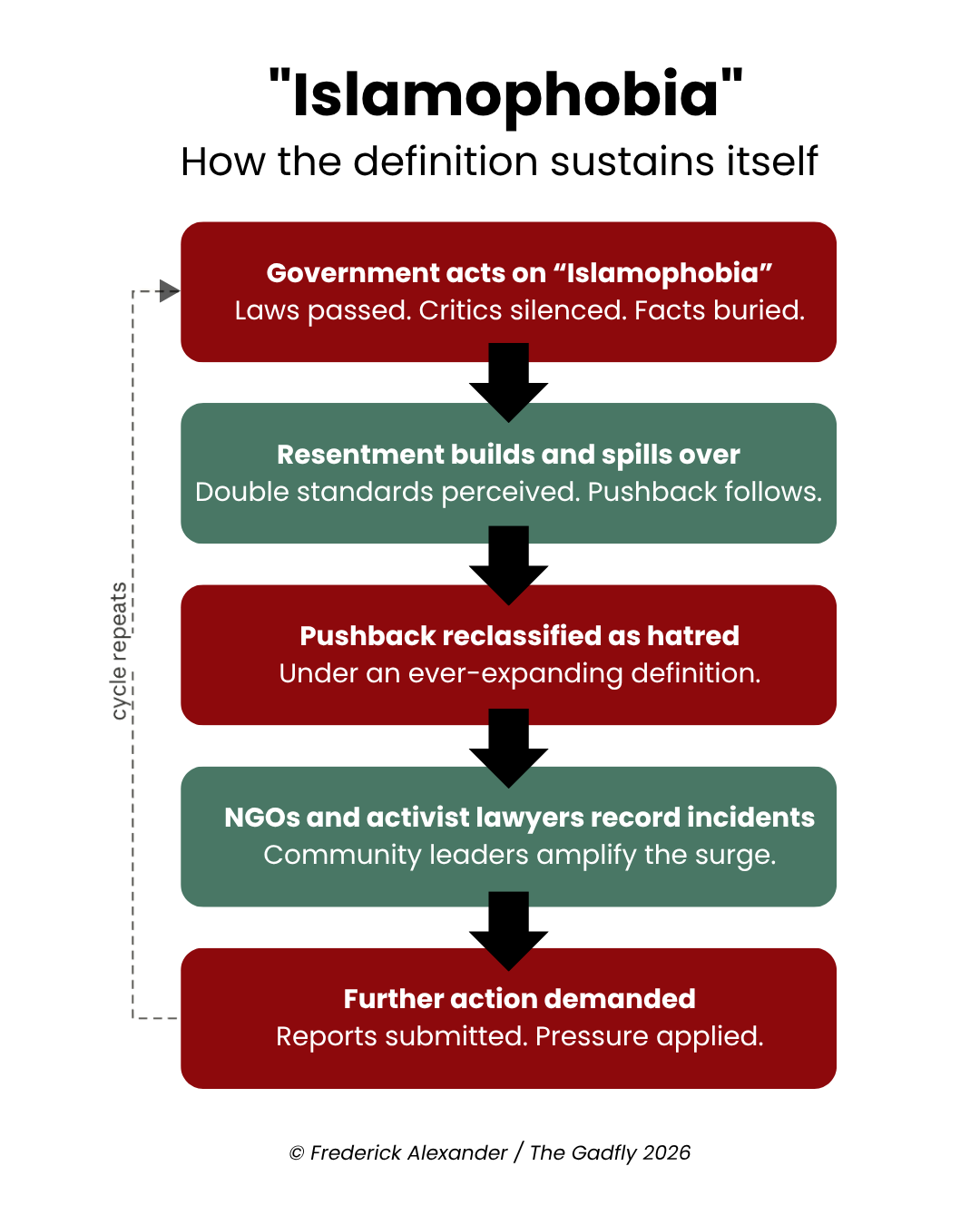
The career-ending accusation of “Islamophobia” has hung over every discussion of Islam in the West for decades. In Britain, which leads the world in self-sabotage, a formal definition has now arrived, rebranded as “anti-Muslim hostility”. It’s carefully worded and accompanied by caveats that claim to protect criticism, ridicule, and academic debate.
Near the end, it drops in a line like an afterthought:
“This is a working definition and, as with all working definitions, it may need to evolve over time as understanding of the issues develops.”
Evolve how? Upon whose “understanding”? It’s not cynical to wonder what this means and where this leads. It’s not an exaggeration to call this a blasphemy law in all but name.
A few days after the definition was formalised, London Mayor Sadiq Khan led a sex-segregated public Islamic prayer session in Trafalgar Square.
Nick Timothy, a member of parliament, remarked:
”Too many are too polite to say this. But mass ritual prayer in public places is an act of domination…I am not suggesting everybody at Trafalgar Square last night is an Islamist. But the domination of public places is straight from the Islamist playbook…”
Timothy’s X post was exactly the kind of thing protected by the definition’s own terms. Still, the Prime Minister responded with synthetic indignation, demanding he be sacked for his "utterly appalling" remarks. The Attorney General, Lord Hermer, opted for whataboutery: “Would they have a problem if I, as a Jewish man, were praying in public?”, he asked – as though the concern were about prayer rather than ideology; as if it wasn't Islamists who were forcing teachers into hiding, threatening autistic children for accidentally scuffing a book, and detonating themselves at pop concerts. As if religion were an irrelevant detail when men were gangraping children on an industrial scale in the forgotten towns and cities of the UK.
“Islamophobia”, in a line often credited to Christopher Hitchens, is “a word created by fascists, and used by cowards, to manipulate morons”.
It's an elegant compression of something we all know to be true – including, and perhaps especially, those who are first to deny it.
The fascists who created it
Theocratic regimes popularised the term “Islamophobia” in the late 1970s after facing criticism of Islamic governance, particularly from dissidents within Muslim-majority countries.
Aided by the burgeoning left-wing NGO industry, they borrowed the moral force of anti-racism by making criticism of Islamic doctrine equivalent to attacking Muslims as people. It’s a move that hides its flagrant dishonesty by tapping into Western sensibilities – the preference for tact and good manners over cultural ineptness. Conflating criticism of Islam with bigotry toward Muslims shields the theology behind the person. What better way to make that scrutiny feel gauche among people who pride themselves on their progressive credentials?
It makes no sense, obviously. As soon as you apply the same logic to other belief systems, it falls apart. Can you critique Christianity without accusations of Christophobia? Can you question Marxism, capitalism, Zionism – any ideology – without being labelled bigoted against its adherents? You know the answer. Secular democratic societies defend these rights scrupulously. Only with Islam have we accepted that scrutinising ideas equals hatred of people.
We first saw this pattern emerge in 1989, when Salman Rushdie went into hiding after publishing a book. Perhaps nothing captured the strangeness of that moment better than Cat Stevens, the singer-songwriter who had converted to Islam and become Yusuf Islam. Here he is, endorsing the murder of a fellow artist in a panel discussion shortly after the fatwa.
Years later, in an astonishing display of victim-blaming, Baroness Shirley Williams, a prominent Liberal Democrat politician, said of Salman Rushdie:
“This is a man who has deeply offended Muslims in a very powerful way, who’s been protected by the British police against threats of suicide [sic] for years and years at great expense to the taxpayer…”
Christopher Hitchens responded by calling the remark “contemptible”, which, of course, it is.
The script has been the same for all Islamist violence ever since. Charlie Hebdo: “They provoked Muslims”. Samuel Paty beheaded: “French secularism is inflexible”. The Batley teacher forced into hiding: “The lesson wasn’t necessary”.
Always, the reflex is to blame the victim rather than the people who follow through on their death threats. Always, the preoccupation is with the supposed offence that was caused, not the murderous response to it.
The cowards who use it
The Batley teacher did nothing other than follow his vocation: to educate young minds and get them thinking critically about the issues of the day. An independent investigation cleared him, but a robust defence of his actions was asking too much, and the school all but abandoned him, because it understood that a disturbed conscience is more bearable than a damaged reputation.
The Batley teacher is just the most famous example. Consider Steven Greer, the Bristol University professor who was fully exonerated after teaching about religious violence. The university dropped his course, leaving him to the wolves. He wore a disguise in his own city.
It’s a calculation made again and again to avoid accusations of racism. It works because a demoralised public will eventually let the matter slide. They’ve seen it all before, and deep down, most know they’d do the same.
The problem is not that we don’t understand what’s happening. Free speech is the only tool that can dismantle a bad idea, and “Islamophobia” is designed to take it out of our hands. We see it clearly. The problem is that we hesitate to say it out loud, because speaking plainly now carries a higher price than staying quiet.
The state has now given this cowardice written form. Although it’s woven in a few caveats which may “evolve”, censorship won’t come primarily from government prosecutions but from every institution pre-emptively protecting itself. Universities will sanitise curricula still more, and publishers will reject “problematic” manuscripts. The state won’t need to silence anyone because everyone will silence themselves.
The UK government has shown no comparable urgency on antisemitism, the one form of hatred visibly intensifying on British streets. It’s driven in large part by the ideology that the new definition of Islamophobia shields from scrutiny. The irony is lost on politicians, who mutter a few words of condemnation, perhaps even sounding like they mean it – although it depends on who's listening.
The morons who are manipulated
We’re not talking about stupid people, not in the ordinary sense. These are educated, influential, and sometimes genuinely compassionate people who have walked headfirst into a linguistic trap. They think defending Muslims against hatred requires defending Islam from criticism, a move they would consider condescending if the same logic were applied to their own beliefs.
Muslims, like every other minority, face their share of discrimination in the West. This is true. Therefore, any criticism of Islamic doctrine must stem from prejudice. This is false. Yet it’s false in a way that allows some people to build a career. A whole industry runs on this category error. The human rights lawyers, NGO officials, activists and journalists all see it and pretend it isn’t there because their careers and status depend on ignoring it. The ayatollah has no clothes.
Consider how odd it would be if Italians complained that criticism of the Mafia was anti-Italian. Why don’t Muslims march through the streets after every new atrocity, declaring “not in our name”, unless they feel cowed by the extreme, ideological wing of their own religion? Or agree with it.
Instead, the activism runs the other way. While women in Tehran burn their hijabs knowing they may be killed for it, a gruesome alliance of wannabe jihadists and weekend revolutionaries parade through Western capitals, openly supporting clerical fascism while their children hold placards of Khamenei, the man whose guards beat Iranian women to death for showing their hair.
Who pays for this moral and intellectual bankruptcy? It’s people like Ayaan Hirsi Ali, who has spent decades advocating for the rights of women and girls, having been denied the same in her native Somalia. She fled the country after surviving genital mutilation and later renounced Islam. In 2004, she collaborated with Dutch filmmaker Theo van Gogh on a film that criticised the treatment of women in Islamic societies. Following the film’s release, Van Gogh was murdered by an extremist, who pinned a death threat to his body. The threat was against Ayaan Hirsi Ali, whom Western progressives have since labelled an “Islamophobe”.
Ayaan Hirsi Ali is just the most famous example. There are countless others whose names we’ll never hear but who bear the same cost of saying obvious things out loud, while their critics win applause for dealing in nothing but moral fraud.
A definition that claims to protect Muslims silences the Muslims who need protecting most – the women fighting for equality and ex-Muslims fleeing religious violence. Watch as they tear off their hijabs while we legislate against hijabophobia.
Britain abolished blasphemy laws in 2008, recognising that protecting ideas from criticism was incompatible with free inquiry. Now, under the auspices of people desperate to display their progressive credentials, blasphemy has returned under new management.
This is Britain in 2026. When the next atrocity arrives – and it’s just a matter of time – the institutions will respond with messages pre-checked against the latest definition of “Islamophobia”. The police will furrow their brows; the politicians will reach for “community tensions” and tell us that diversity is strength while the bodies are still warm. And the rest of us will be expected to shrug our shoulders, say nothing, and pretend this is normal.
The Batley teacher will likely spend the rest of his life in hiding.
This is a revised and updated version of a piece published in October 2025.
If you’d like to support this work, subscribe or upgrade below.
You might also like:


Next week's piece (if I can finish it by then) will be on postmodernism, which has done so much to bring about the West's current disarray. I've dusted off my old philosophy books (I studied Derrida and Foucault, among others, at university – and was suspicious of it all even then, 25 years ago). I hope to present a clear account of how it turned the West's immune system against itself.
Be sure to subscribe if you’d like to get that to your inbox.
Superb as ever and chilling. If the people in charge had an iota of backbone and foresight this could have been nipped in the bud. The Muslim Brotherhood is banned in many Islamic countries because they saw the threat from radical Islam and didn’t want it. Instead the radicals have set up shop across the West and they’ve been welcomed with open arms by our ‘dear leaders’. The radicals are using our freedoms against us and are laughing as they take over. And what does Labour do? - double down with even more curbs on our ability to even debate the issues.
https://m.youtube.com/watch?v=roD1SVDePF8