


I’m wary of calling people I disagree with stupid because, first, I am stupid in any number of ways and, second, “you’re stupid” is not, by itself, an argument. A decade ago, we saw the managerial class use the “you’re stupid” tactic to demean Brexit voters and Trump supporters as low-IQ blockheads – plumbers and the like. The big, important decisions, they were careful to point out, should be left to people who’ve been to university and understand how things are. They’ve been patiently explaining the world to the rest of us ever since.
But it turns out the progressive managerial class doesn’t understand things. It knows things, certainly – how to pass exams, work the system and recite the correct talking points and shibboleths. Meanwhile, the wider public has been slow to notice what’s going on because most people have better things to do than watch the circus unfold on Twitter. Many still take the BBC and other mainstream media for more or less trustworthy voices of reason rather than ideological partisans selecting facts to fit the approved narrative. That is now changing, and a rather different conclusion is taking hold: there is no more confidently stupid group of people in the world than the reality-illiterate, badge-wearing progressives who occupy our institutions today.
Consider what you have to believe, or at least nod along to, inside one of our institutions if you want to avoid getting hammered. The obvious ones first: men can become women by putting a dress on; race is a meaningless social construct but also the most important thing about you; unequal outcomes are incontrovertible evidence of prejudice, except where the outcomes favour the groups we like, in which case it’s social justice. Then we have inclusion, which is an ultimate good – except where it includes the people we’ve just decided were the cause of the unequal outcomes, in which case we must ruthlessly exclude them. Then there’s the thorny issue of censorship, which is vital for that most sacred of things: democracy. But democracy is under constant threat from people who vote the wrong way (those plumbers again), hence the censorship. And hovering above all this, the broad agreement that the West is uniquely wicked despite millions of people desperate to move here, whom we are, by the way, morally obliged to accommodate. Well, not “us” – we like our little corner as it is – but everyone else, who never got a say but must do the accommodating in any case.
There are more sophisticated ways of stating each of these propositions, of course. Put to music with carefully selected imagery, the media can convince polite society of any of them. The sophistication is part of the trick. Orwell called it doublethink: the ability to know and not know at once, to “use logic against logic” until the contradiction no longer feels like a contradiction but evidence of one’s intelligence. That is the stupidity I’m talking about: not the absence of knowledge, but a cultivated myopia – the ability not to see what is directly in front of you.
And then there’s the hypocrisy. In Britain, the same people gather in a field in Somerset once a year at the festival of groupthink we call Glastonbury. They will enthusiastically promote open borders inside an event whose security perimeter makes the Berlin Wall look like a bead curtain. They will chant “Death, death to the IDF” in an act of deranged karaoke and come away from it surfing a high of moral adrenaline. Between the sets and sing-alongs, there will be lots of worthy little events about protecting the environment, including “awareness-raising” talks on climate catastrophe and plastic pollution. Then the crowd will leave behind something resembling a landfill, its abandoned tents and plastic rubbish to be cleared by low-paid manual labourers.
Beyond the doublethink and the hypocrisy, there’s the credentialled moral vanity – the kind advertised in a LinkedIn bio: the Certified Scrum Master and Innovation Evangelist who’s also “amplifying marginalised voices” and a “proud ally” of whichever group is trending this week. These people run the country.
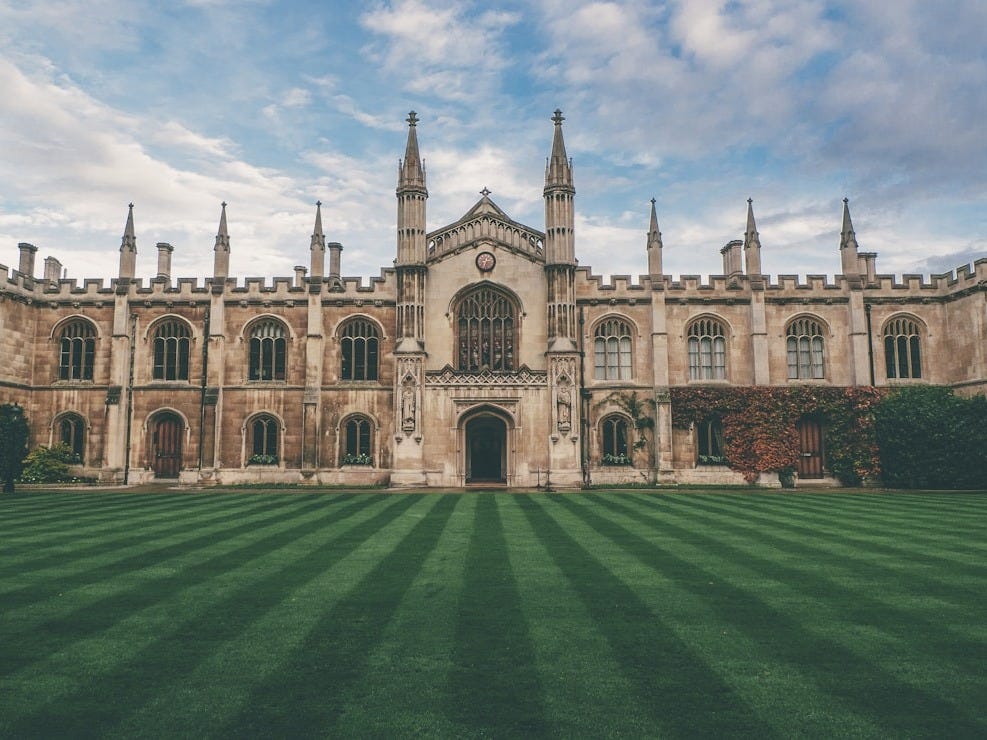
Perhaps no recent episode better illustrates the folly of the educated than Cambridge’s appointment of Jason Arday and everything that followed. There’s more than one tragedy at the centre of this story, and the one that concerns me here belongs to Cambridge itself – or rather to the academy as a whole, which I can’t help feeling died some time ago. A version of it, anyway. In its place is something that looks the same on the surface but is pulled towards commerce on one side and activism on the other, with ideology filling the vacuum where the pursuit of truth used to be.
If Cambridge had been serious about its own standards, it would have checked Arday’s work at the outset. It didn’t because it saw a symbol and an opportunity to bolster its reputation among its own congregation (and, as it turned out, ruin it in the process). The university as an institution grew from the cathedral and monastic schools of medieval Christianity and today resembles a seminary for the new religion of social justice. Humanities departments especially have become schools of orthodoxy once again, with their new priests and doctrines, magic words and miracle stories.
The academy got away with it for years. Arday is simply where the public has finally caught up with a transformation long since complete.
None of it would have been possible if the progressive class had not pulled off a rather brilliant trick. First, turn common sense on its head by denying something everyone has understood for millennia – what a woman is, for example, or why borders matter – and then characterise anyone who raises an objection as reactionary and unreasonable. Take the WNBA, which has spent the summer unable to say what a woman is, insisting with straight faces that there’s nothing especially interesting or important about the question.
But there is something interesting about it – in the way it would be interesting if dolphins were admitted to Olympic swimming events.
“How fascinating,” you might say, watching the bottlenose finish a race the bipeds have barely started. “Probably not a fair contest, though?”
“Nah, it’s fine,” comes the response, a very slight impatience creeping into the exchange.
“But it’s a dolphin,” you say.
“Why do you care so much? Why are you obsessed with dolphins?!”
This is essentially the conversation we’ve been having for a decade, and not just about gender but about reality itself. And it’s always that tone, the pretence of not understanding what the objection is. You’re up against someone in a lanyard who presents himself as neutral while casting you as somehow abnormal. If you push the point, you’re then charged with intellectual or moral failure – worse, a mental disorder in the form of a phobia.
“Perhaps we should look at the prevalence of cousin marriage and its consequences for children…”
“That’s Islamophobic.”
“Maybe we should let children reach eighteen before removing healthy body parts…”
“That’s transphobic.”
“I’m not sure a man whose PhD reads like a thesaurus in a blender was the right choice for a Cambridge professorship…”
“That’s racist.”
The question doesn’t need to be answered because the person asking it has been diagnosed as unfit for further comment.
It works because most people would rather not spend their days being called a bigot and a racist by somebody who does this for a living. The policymakers and the professionally offended, the opportunists and the self-declared victims – in short, the progressive class – don’t have to explain why the policy makes sense if they can persuade everyone else that only a bigot would question it. This is how polite society has been captured and coerced into repeating things they do not believe or keeping quiet about things they know are absurd.
Meanwhile, the powerfully stupid and the stupidly powerful have their mitts on the wheel, steering an alternately baffled and furious population around in a rainbow-coloured, ethically sourced funbus while China, Qatar and other hostile regimes with no intention of importing any of this watch from the roadside, stifle their giggles and provide the fuel.

You might also like:


Someone quipped to me years ago that P.H.D. stood for Post Hole Diggers. It wasn't meant to disparage education per se, but to point out that a PHD could be stupid in a very practical sense. The plumber, on the other hand, is practical, and it was a plumber who made the quip to me.
Dear Frederick,
I am sending this to our Future of the American University Committee members. You have made the case for reality beautifully!
thanks,
randy