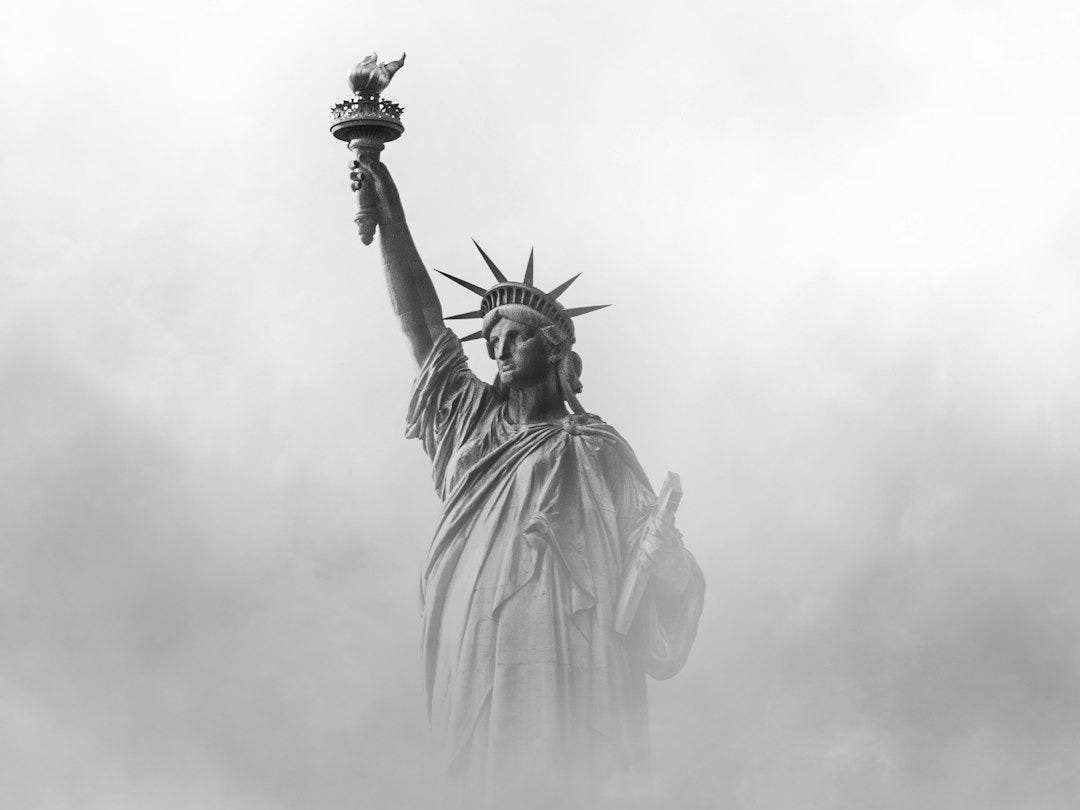
America, the Impossible Superpower
While Europe decays and China surveils, America still believes it can do anything.
America has a remarkable way of treating the impossible like a logistics problem. In 1961, after the country had put a man in space for all of fifteen minutes, President Kennedy promised to go one step further. A giant leap further, in fact. America spent the GDP of a mid-sized country, employed 400,000 of the finest minds of a generation, built things, broke them, built them again, and finally strapped three men to a rocket with less computing power than a washing machine. Somehow, within eight years of setting the target, and only 66 years after inventing powered flight, it landed a man on the moon.
What other power could have achieved such a thing, let alone dreamed it? The USSR had ambitions, certainly, but ultimately didn’t have the right stuff. Today, the European Union – which resembles the USSR in some ways, although not in industrial output – looks at Elon Musk’s rocket catcher and shakes its head. Not out of awed disbelief, but because it knows, on some fundamental level, that it simply doesn’t have what it takes to realise such an implausible ambition. It won’t admit as much, of course, instead muttering to itself something about the rocket’s carbon emissions or a lost opportunity for regulatory paperwork.
There’s a meme for this, and every European technocrat knows it as an unanswerable humiliation.
The contrast could hardly be more absurd. While SpaceX catches a 275-tonne rocket booster mid-air, the European Union puts its best minds to a bottle cap tethered to the body by a plastic strap. In their way, these achievements represent the limit of what each civilisation believes itself capable of. On one side, an engineering miracle signalling hope and the spirit of adventure. On the other, a consumer irritation mandated into existence by environmental regulations.1
America wasn’t the first nation to think impossible things and bring them into being through sheer swagger. Britain, which today leads the world in decline, once had an empire on which the sun never set. That’s quite an achievement for a damp little archipelago off the coast of mainland Europe.
There are genuine sins of empire, and no serious person should deny them. But the narrative pushed in schools and universities that British colonialism was an uninterrupted campaign of evil and exploitation is simply nonsense2. Consider all the extraordinary innovations and developments Britain achieved and shared with the world when confidence ran high. Parliamentary democracy, common law, liberalism, capitalism, the novel, penicillin – the list goes on. Britain practically invented the modern world. It also helped end the slave trade at considerable cost to itself. No nation is perfect, but few have so disproportionately influenced the world for good.
Britain built the first railways, too. How extraordinary, then, that two centuries later it struggles to build a new line between its two biggest cities, barely a hundred miles apart. HS2 was meant to connect London to the North, but after years of mismanagement and escalating costs, it will now connect London to Birmingham and not much else. The leg to Manchester was cancelled outright, while a £100 million structure to protect bats from the trains somehow survived the axe – and it might not even work. Kennedy got a man to the moon in eight years. Britain has spent longer than that failing to deliver a single high-speed rail line. The total estimated cost is around £100 billion, but the real cost is national humiliation. The Chinese must look at this with amused disdain. They’ve built dozens of HS2s in the last decade alone, which is why their model now tempts weak Western elites.
Britain is the cautionary tale, proof that a people can talk itself out of optimism within a couple of generations. A can-do attitude is a resource that depletes fast, and all the hand-wringing and virtue-signalling in the world won’t bring it back.
Why does any of this matter, you might ask? So what if Britain is in self-imposed decline? Who cares if the EU can’t tie its own shoelaces without first running them through a regulatory framework? None of that is America’s problem.
It matters because, for all the irritations of the Old World, we share the same values in the end. I want America to win because I want the West to win – the best version of it, anyway. This is our inheritance, paid for by the generations who died in their millions to defend it. Now it’s being squandered by an elite class embarrassed by the West’s success and convinced that every problem requires more state intervention. Not surprisingly, those elites look less to America for clues about how to build things and more to China for clues about how to manage them.
I lived in China for years. Chinese people are the same as you and me in the way all people are the same: the same dreams and worries, the same love of family, the same preoccupation with status, exams, property prices and whether their children are doing well enough.
But there is a different software running underneath, part of its Confucian inheritance. It prizes order, harmony, hierarchy and competent management above almost everything else. The Chinese Communist Party doubtless exploits some of these instincts, although it also imported the West’s worst-ever idea, Marxism, and made it its own – because it’s ultimately interested in power. It despises our democratic norms, not least because its survival depends on rejecting them.
As for the Chinese people, most understand perfectly well what democracy means and why Westerners want it. But they also see the same thing we see: the unending quarrel we have with ourselves. The marches and lawsuits, the deranged students, the collapsing institutions, the elections that leave everyone furious and nothing settled.
As long as the CCP delivers prosperity, raises living standards, keeps violent criminals off the streets and lets everyone else live in peace – albeit inside a surveillance state – many will accept the trade-off. Tiananmen Square showed what happens when the allure of freedom threatens the Party’s monopoly on power. It has no intention of letting things get out of hand like that again. Its response to COVID showed the world what that promise looks like in practice. The police didn’t think twice about welding people into their own homes. The white-suited officials moving through the streets looked like a low-budget dystopia, and that’s just the stuff that was caught on camera. The message was clear: we are in charge here. Play nice or else.
The point is not that the CCP is uniquely cruel, though it’s certainly that. The managed society doesn’t need to be cruel to be a trap, and we can see that even in its most attractive versions.3 The trouble is that top-down management has no off switch, because there is no situation in which more order doesn’t appear to benefit the “good” society, and every risk that personal freedom might subtract from it. The managed society always has a reason to manage more.
That is the bargain increasingly tempting Britain, Europe and, no doubt, America’s progressive aristocracy. We’ve been here before, of course: the state having more control of your life for your own good has the unmistakable smell of socialism. The educated and intellectual class are drawn to the idea because they assume they’ll be the ones running things. They’ll call it “democratic socialism”, but what they really want is China’s Lenovo-Leninism with rainbow flags. This is the socialism of compliance frameworks, managed speech and approved opinion. They want the machinery of order in the service of fashionable projects that undermine the social trust on which freedom depends.
Worryingly, an alarming number of voters want the same thing, if the pandemic is anything to go by. The curtain-twitching, the snitching, the strange moral thrill of telling other people what they were allowed to do – COVID revealed a faultline between two types of people in our societies, between those who want safety first and the rest who value freedom above all. Americans tend to be on the freedom-loving side, which is why even the parts of their political culture Europeans find baffling often make more sense when seen as expressions of an older suspicion of state power.
This is not to say America is anything like perfect. US politics is as ugly as any nation’s, all the more so because it’s put under a media microscope and served up into everybody’s newsfeed every day. Its healthcare system is hardly the envy of the world, and its ideas about maternity leave and gun ownership and a host of other things can be gasp-inducing. It has conspiracy loons on the right who think the moon landing was faked and hobbyist revolutionaries on the left who think the freedoms that make their protests possible are also, somehow, the problem. It has all the same useful idiots as the rest of us, but with bigger megaphones and an unhappy way of exporting their terrible ideas around the globe.
But, my American friends, none of that is the point – at least not today. As the world looks at your great nation now 250 years young, we see a country that still believes the future is something you make, not something that happens to you. You’re a people who look at a desert and imagine Las Vegas, or at a falling rocket and wonder whether it might be caught.
Your politics might look like reality TV without the meds, but you’ve been here before and come out the stronger for it. In another fifty years, today’s dramas will look like a blip, and you’ll be wrestling with a fresh set of problems, some of them insane, some of them magnificent.
Whatever the future holds, may you remain loud, infuriating, inventive, and free.
Happy 250th birthday, America.
The Gadfly recently passed 3,000 subscribers. If you’d like to support my writing, consider subscribing for free or upgrading. A paid subscription is 30% off until the end of the week and gives you access to the comment section and the archive.
I’m all for preventing litter – I’ve written about it. This isn’t really a comment about bottle caps, but about how the meme so neatly captures the different ways the US and the EU think about innovation. For the background on the tethered-cap rule, see here.
As Andrew Roberts puts it, with heavy irony, Churchill saw the British Raj as having brought railways, irrigation, universities, legal order, medical advances, famine coordination and the abolition of suttee. It was not, in his view, “the sinister and paternalist oppression that we now know it to have been.” See the full quote here.
Singapore has order, competence, clean streets, serious schools, low crime and one of the highest standards of living on earth. Lee Kuan Yew built it on the conviction that liberal democracy was not the natural destination of every society – that order and competence mattered more. The odds of getting mugged in Singapore are on a par with alien abduction. In parts of London, meanwhile, mugging is the least of your worries. Singapore makes no apology for order. London’s mayor says that when you live in a great global city, you have to be prepared for all sorts of things. He’s not talking about Shakespeare in the park. He means stabbings. And yet even Singapore, the managed society at its most benign, cannot always locate the off switch. The same state that gives you clean streets and safe trains routinely investigates, fines, and prosecutes its critics, and sees nothing troubling in it.


Good column. It is true.
Dont want to side track, but I did not get the bottle top reference. Is that something in England?
Thank you for that birthday gift.