The Terrible Idea That Will Not Die
Malthusianism and the population panic that never goes away.


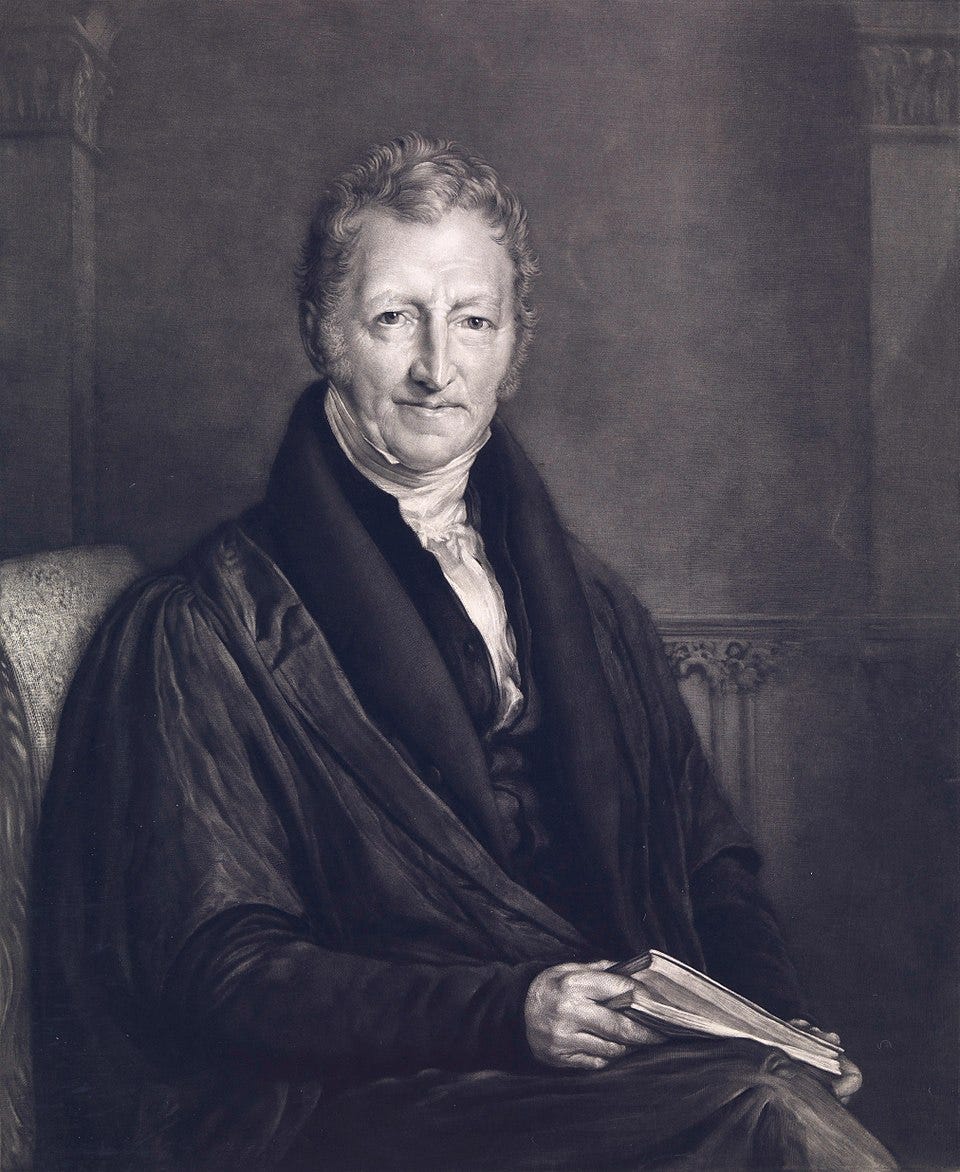
In 1798, a mild-mannered English clergyman named Thomas Robert Malthus discovered something terrifying. Poor people were having sex. Not only that, but they were producing babies. Worse still, these babies were demanding food.
Naturally appalled by these observations, Malthus set himself to the task of forming an economic theory. In his Essay on the Principle of Population, he argued that human populations grow geometrically – 2, 4, 8, 16. Land, however, is finite. Agriculture improves only slowly. Food production grows arithmetically – 1, 2, 3, 4. Any fool could surmise from these calculations that population growth would soon outstrip the food supply, leading inevitably to starvation and misery.
Fortunately, the solution disclosed itself through the same logic. Charity towards the poor would only lead to them having more children, in turn exacerbating the demand for food and the need for further charity. It was unsustainable. The only forces preventing immediate catastrophe were what Malthus cheerfully called “positive checks”: war, disease, and famine. There were also “preventive checks”, such as late marriage and moral restraint. The poor, lacking the moral fibre for the latter, would breed to the point of starvation.
The solution was to let the natural order of things run its course: famine as the cure for starvation.
Within a generation, Malthusianism had become the respectable excuse – indeed, the “compassionate” excuse – for the well-off to do nothing about poverty. The mathematics were irrefutable. The matter was settled.
There was just one problem with this elegant bit of reasoning.
It was nonsense.