

For many people today, and the young especially, a conservative is someone who is suspicious of the future and allergic to progress. It’s the reactionary who wants to preserve the status quo because the status quo preserves his power and influence. It’s the stiff in tweed sitting in a house he bought 50 years ago for the price of a vanilla latte, complaining about “the youth today” while foaming at stories in the Daily Mail about immigrants.
The thinkers below had no patience for these caricatures, and neither should you. What unites the conservatives we're looking at here is an understanding that good things are fragile and that traditions are often inherited forms of knowledge and wisdom. For conservatives, the work of building civilised institutions is slow, difficult, and even a little dull. But they understand that tearing them down, while thrilling and self-flattering, is also often irreversible.
None of which is to say that reform is bad. The conservative disposition, rightly understood, is about the insistence on knowing what it is you’re reforming and why. Before you tear down the fence in the field, find out why someone built it. If you’re incurious about that question or hold it in disdain, the rest of us might fairly wonder who gave you permission to act on our behalf and what the consequences might be. History has repeatedly shown us that when those questions don’t arise, or can’t arise in an unfree society, catastrophe awaits.
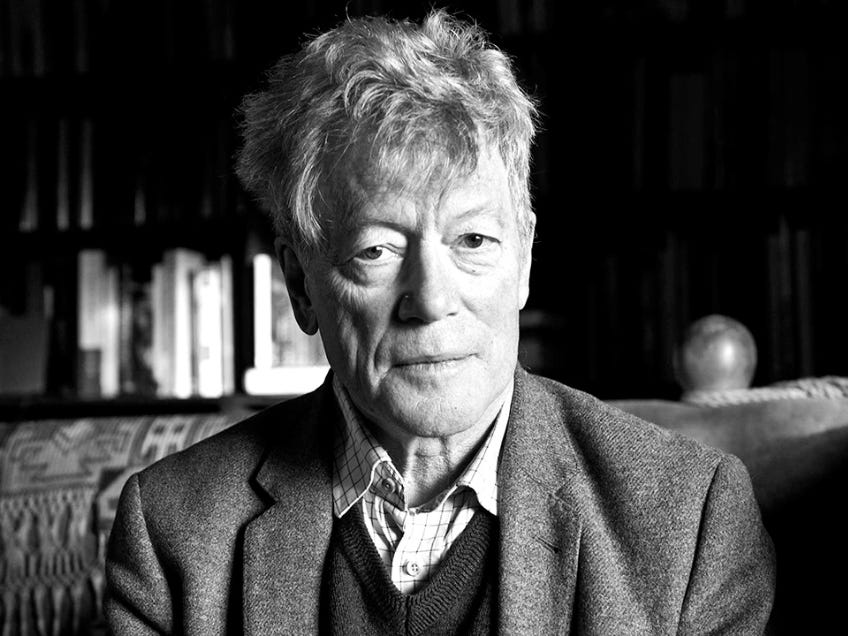
This selection of quotes below features Roger Scruton above all because he distilled, better than almost anyone since Chesterton (who gave his name to the fence above), the qualities of the conservative disposition. Things like gratitude, restraint, and piety toward the past, as well as the tragic sense of human nature and the suspicion of schemes that promise liberation while dissolving the conditions that make freedom possible.
You will also find Burke, Scruton’s great inspiration, who looked on as a revolution that promised heaven delivered the guillotine instead. His warnings about the French Revolution helped form one of the foundational texts of modern conservatism. The forces he feared – fanaticism, political vanity, and the loss of temperance – lurk at the edge of any society that forgets how fragile civilisation is, which is to say every society we care to look at today.
Chesterton is here too, because he spotted early on the arrogance of a managerial class busily dismantling things they had not first taken the trouble to understand. This, of course, is the class of people that incur so much of the public wrath today, and for precisely these reasons.
Taken together, these quotes offer a brief introduction to the conservative disposition: the inclination to defend our inheritance against those who despise it or merely don’t understand it, or wilfully misunderstand it. The same inclination emphasises gratitude over vanity and favours careful, thoughtful change over the modern belief that sweeping things away is a form of cultural intelligence rather than reckless naivety.

“Conservatism starts from a sentiment that all mature people can readily share: the sentiment that good things are easily destroyed, but not easily created... In respect of such things, the work of destruction is quick, easy and exhilarating; the work of creation is slow, laborious and dull. That is one of the lessons of the twentieth century. It is also one reason why conservatives suffer such a disadvantage when it comes to public opinion. Their position is true but boring, that of their opponents exciting but false.”
— Roger Scruton
“Society is, indeed, a contract. Subordinate contracts for objects of mere occasional interest may be dissolved at pleasure; but the state ought not to be considered as nothing better than a partnership agreement in a trade of pepper and coffee, calico or tobacco, or some other such low concern, to be taken up for a little temporary interest, and to be dissolved by the fancy of the parties. It is to looked on with other reverence; because it is not a partnership in things subservient only to the gross animal existence of a temporary and perishable nature. It is a partnership in all science, a partnership in all art, a partnership in every virtue and in all perfection. As the ends of such a partnership cannot be obtained in many generations, it becomes a partnership not only between those who are living, but between those who are living, those who are dead, and those who are to be born.”
— Edmund Burke
“Each new generation born is in effect an invasion of civilization by little barbarians, who must be civilized before it is too late.”
— Thomas Sowell
“To be conservative is to prefer the familiar to the unknown, to prefer the tried to the untried, fact to mystery, the actual to the possible, the limited to the unbounded, the near to the distant, the sufficient to the superabundant, the convenient to the perfect, present laughter to utopian bliss.”
— Michael Oakeshott
“Tradition means giving a vote to the most obscure of all classes, our ancestors. It is the democracy of the dead. Tradition refuses to submit to the small and arrogant oligarchy of those who merely happen to be walking about.”
— G.K. Chesterton
“Conservatism is more an instinct than an idea. But it’s the instinct that I think we all ultimately share, at least if we are happy in this world. It’s the instinct to hold on to what we love, to protect it from degradation and violence and to build our lives around it.”
— Roger Scruton
“A conservative temperament has something to do with a deep understanding of the inherent value of the world, and its vulnerable and precarious nature. It is suspicious of the impulse to tear things down, dismantle things, cancel things, burn things to the ground... The conservative understands about loss and about grief.”
— Nick Cave
“All conservatism is based upon the idea that if you leave things alone you leave them as they are. But you do not. If you leave a thing alone you leave it to a torrent of change.”
— G.K. Chesterton
“Tradition is not the worship of ashes, but the preservation of fire”
―Gustav Mahler
“For the conservative, human beings come into this world burdened by obligations, and subject to institutions and traditions that contain within them a precious inheritance of wisdom, without which the exercise of freedom is as likely to destroy human rights and entitlements as to enhance them.”
— Roger Scruton
“The whole modern world has divided itself into Conservatives and Progressives. The business of Progressives is to go on making mistakes. The business of Conservatives is to prevent mistakes from being corrected... Thus we have two great types — the advanced person who rushes us into ruin, and the retrospective person who admires the ruins.”
— G.K. Chesterton
“Left-wing people find it very hard to get on with right-wing people, because they believe that they are evil. Whereas I have no problem getting on with left-wing people, because I simply believe that they are mistaken.”
— Roger Scruton

You might also like:


All of these are true for certain contexts and deserve reflection by those of any political persuasion.
“…the actual to the possible…” —Oakeshott
“Conservatism is more an instinct than an idea. But it’s the instinct that I think we all ultimately share, at least if we are happy in this world. It’s the instinct to hold on to what we love, to protect it from degradation and violence and to build our lives around it.”
— Roger Scruton
I was born unwanted, in mean circumstances to a fractured family group beleaguered by poverty and physical and mental infirmity. There was very little love to hold on to and what little there was had no power. There was nothing for me to build a life around, nothing to conserve.
The actual, in my life, was never going to be preferable to the possible. If I had not held on to the possibilities of something better and worked to make my escape, I would be dead.
Not everything is worth conserving. Slavery, for instance. Women’s indentured servitude to men. The penalties for being gay. Sometimes things have to change because some of our “traditions” are predicated upon exploitation or ignorance. Humans can be a greedy, superstitious lot at times.
This is where liberalism shines. It opens space for new possibilities and corrections to the conventional wisdom, which every society needs from time to time. It is for this reason that I am and will remain a liberal politically in spite of how I am currently voting (as Sowell constantly reminds us, life requires trade offs).
That said, balance is required.
“For the conservative, human beings come into this world burdened by obligations, and subject to institutions and traditions that contain within them a precious inheritance of wisdom, without which the exercise of freedom is as likely to destroy human rights and entitlements as to enhance them.”
— Roger Scruton
Too much freedom and too little responsibility does not a balanced polity make. We must exercise enough discipline and forbearance to uphold our institutions if we want to be able to enjoy the fruits of Western civilization. I served in the military because I felt it was my duty to protect the ideals of my country. Without the ability to self determine, I would have been stuck in a horror show of a family group and my life would have been much degraded and far shorter. So, the promise of the US Constitution was and is personal for me. And I will fight to preserve it until the day I die, up to and including voting for Republicans until the left exercises some maturity and some restraint, if that is even possible. They are so high on sanctimony and theory right now that they might never come down.
I believe in nation states (globalism has been a disaster and a grift) and ideals and free speech and association. I believe in tradition and duty, but also in the freedom to determine our own course in life and unfold possibility in new ways. But these beliefs are always in tension. Discernment is required dependent on context. Too far one way and we stagnate. Too far the other and we fall off the cliff.
Here’s hoping we can exercise the wisdom to find a middle ground of creative tension. It feels both far away and right around the corner at present.
Great quotes! I was not aware that Nick Cave is also a deep thinker.