

Many years ago, when Britain was still a vaguely serious country and “soft power” didn’t sound like a punchline, I spent time working in China doing my bit for Sino-UK relations. I occasionally visited Xinjiang – a vast western province home to the Uyghurs, a Muslim minority now subject to mass internment, forced labour and what several governments have formally recognised as genocide.
The Uyghurs I met were friendly and curious, getting on with the business of living like everyone else in that watchful country. I’ve thought about them occasionally over the years. I wonder how many are suffering under the CCP’s brutality today.
I don’t expect to see mass marches through London or New York for the Uyghurs any time soon. No trending hashtags, no flags in bios or TikTok sermons. True, a handful of activists keep vigil outside embassies, but they go largely unnoticed. Meanwhile, the big NGOs barely mention them, and celebrity activists – usually so keen to side with the oppressed – have more suitable causes to amplify.
To someone unfamiliar with the moral rot running through these movements and institutions, these omissions would look inconsistent at best. For those of us paying attention, it’s all grimly predictable – selective outrage on questions of Islam being a signature move of today’s left.
Consider Hannah Spencer, a Green Party candidate in a recent British by-election. Matt Goodwin asked her on television the simplest of questions about terrorism in Britain, specifically about a night almost a decade ago that saw 22 people murdered – ten under the age of 20, the youngest an eight-year-old girl.
“Why are those things happening?”
The answer, of course, is a simple word: Islamism. Yet Spencer couldn’t say it because in left-wing politics, “Islamism” is treated like a swear word at a children’s party. Instead, the question triggers an automated response. Attacks like Manchester happen, she said, “because people like you are dividing people”.
There it is. If the bomber had been a white supremacist with a Hitler tattoo, would she have struggled to say “Nazi”? Of course not. She’d have jumped up on the sofa and bellowed it from a megaphone. But the word “Islamism” works like a hypnotist’s trick on a certain type of person. The word “Islam” in any negative context is even worse. Snap your fingers and suddenly politicians are incapable of forming the word, instead looking baffled and indignant.
Spencer isn’t an oddball at the edge of Western politics. She is our politics today, albeit someone less fluent in the language of evasion. She merely said what an entire class has been hypnotised to think. Her only mistake was to say out loud what more seasoned politicians obfuscate and dissemble.
None of this emerges from nowhere. Behind the hypnotised political class are the movements that do the hypnotising, and they recruit a very specific psychological type – often in much larger numbers than we usually care to admit.
You’ve met someone like this. You’ve probably muted them on WhatsApp. It’s what satirist P.J. O’Rourke called the spoiled child – “miserable, as all spoiled children are, unsatisfied, demanding, ill-disciplined, despotic and useless.” He was talking about the left, but every political tribe breeds its own variety. The right has its own, as I’ve written elsewhere.
Nevertheless, the spoiled child finds communism or radical Islam especially irresistible because these ideologies divide the world into simple binaries of oppressor and oppressed, believer and infidel. Like all utopian systems, they come packaged with slogans and flags and answers to everything. They excite the despotic and the useless because they promise control and eliminate the need to think too much or wrestle with complexity.
It’s a human instinct most of us grow out of: the fantasy of being finally in charge. But for the spoiled child, it’s a chance to settle things in accordance with – what, exactly? God’s law? The natural order of things? Justice? These are secondary considerations to an impulse that is simpler and uglier than any ideology.
Which brings us to Poppy and Abdul. While Poppy waves rainbow flags in solidarity with gays, Abdul, an Islamist, dreams of throwing them off the nearest building.
It’s a coalition that makes no sense. Until you look at the psychology.
Expensively educated and furnished with a generous trust fund, Poppy is miserable. Why? Because the world has persistently failed to notice her talents and inherent goodness while writing her off as a “privileged white kid”. Fortunately there’s a solution for this increasingly common ailment: moral exhibitionism.
On a typical day, Poppy gets up around 10am. Her first order of business is to run a status audit – follower counts, likes and shares, etc. Disappointed, she reaches for her MacBook Air, resolving to put in a good day’s work on Bluesky, starting with a meme she’s plagiarised about abolishing Israel (not the Jews though “cos they can go back to Poland” or something). Later she orders a new keffiyeh on Amazon (made in China), briefly updates her pronouns from she/they to ze/zir, then changes them back when she notices her frenemy Saffron has had the same idea. By 7pm she’s exhausted and loses herself in a quiet reverie about chucking soup at an oil painting for World Environment Day.
In case it’s not blindingly obvious by now, Poppy isn’t fighting for the oppressed. She’s performing fighting for the oppressed, which is considerably easier and makes for much better Instagram reels. What she’s actually fighting for is the recognition she has always felt was owed to her – and which the world has been unreasonably slow to provide.
Then there’s Abdul. He grew up in a world that was considerably harsher – one that promised dignity but delivered humiliation. Or at least that’s how it felt, which for our purposes is what matters. Islamism finds him at exactly the right moment, offering purpose, cosmic importance, and a villain. Despite the torture of it at the time, he’s now relieved his father forced him to memorise the relevant texts and attend those study circles. He’s emerged from both experiences fully bearded and boiling with rage. A man in his father’s image, he’s utterly certain that the problem with the world is other people’s freedom.
Poppy and Abdul are running the same psychological malware of resentment, grievance and hunger for status. Only the hardware is different.
Both experience themselves as losing a game they most want to win. And people who experience themselves as losing don’t conclude they came up short – that would require a degree of self-awareness that Poppy and Abdul have carefully avoided developing. They conclude instead that the game is rigged. And a rigged game justifies any response.
So they use each other, each convinced the other hasn’t noticed they’re a pawn. Poppy thinks she’s in solidarity with the global oppressed. Abdul thinks he’s using the useful idiots of the West for cover – which, to be fair, he is. It’s the least self-aware coalition in political history, which is genuinely saying something given the competition.
Poppy and Abdul have been in each other’s orbit for years. What finally brought them together was October 7th. Or rather, Palestine’s “evil oppressor”, Israel. Or rather, the Jews: that tiny minority whose stubborn success under centuries of hostility is an affront to anyone whose worldview depends on their own failure being someone else’s fault.
Of course, Israel’s enemies are not merely sadists with parachutes but global institutions pretending to be humanitarian. The UN has passed more resolutions condemning Israel than all other countries, including Russia, China, and Iran combined. The NGOs have followed suit. Amnesty, Human Rights Watch and the rest – organisations that began as genuine moral enterprises – are today more like lifestyle brands for holders of luxury beliefs. Poppy naturally finds them enormously validating.
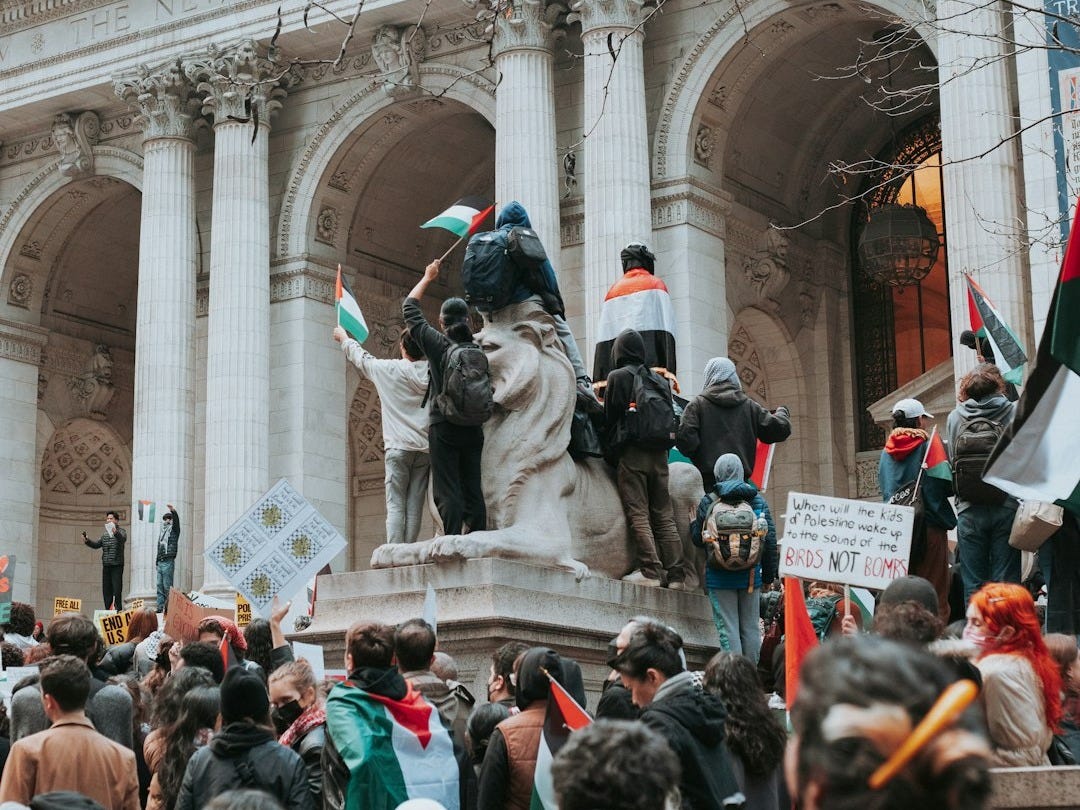
Abdul meanwhile attends the weekend march, placards and banners helpfully supplied by persons unknown. One day he finds himself walking alongside Poppy, whose posh vowels and presumptuous declarations of solidarity irritate everyone around her, save the other middle-class white people who think she’s brave and amazing.
Abdul finds Poppy insufferable. Poppy finds Abdul “authentic”. Both think Israel is evil. Abdul understands at some basic strategic level that he has to endure Poppy for now. When the caliphate comes, that arrangement will be revisited.
What both have in surplus is utter certainty that they are right, that history will vindicate them, and that the ends justify practically any means.
Which is why the Uyghurs get ignored and Iran barely registers. Palestinian suffering is useful. Uyghur suffering isn't – because China isn’t the right kind of oppressor and Amnesty hasn’t figured out how to blame it on the West.
None of this would matter if the adults were in the room. They’re not. That’s the actual crisis of our politics right now – not Poppy throwing paint at things or Abdul’s nurtured sense of humiliation. The problem is a political class that indulges both, mistaking noise for moral clarity and tantrums for politics.
A mature democracy doesn’t negotiate with either. It names them, refuses to indulge them, and gets on with governing.
Ours has forgotten how.
You might also like:


There’s plenty here to disagree with, I’m sure. Have at it below. If you found it worth reading, give it a like or share.
I’ll be covering new terrain over the next few posts. Next Sunday’s essay will likely be on the conservative disposition.
Boom absolutely love it Frederick spot on (though being picky I might argue that Poppy isnt quite as resentful as Abdul). I feel that would be an excellent story or novel or satire here about how the two's paths run parallel and eventually collide.