
John Cleese and the Death of Satire
Why an 86-year-old comedian is still doing the job that younger comedians won’t.

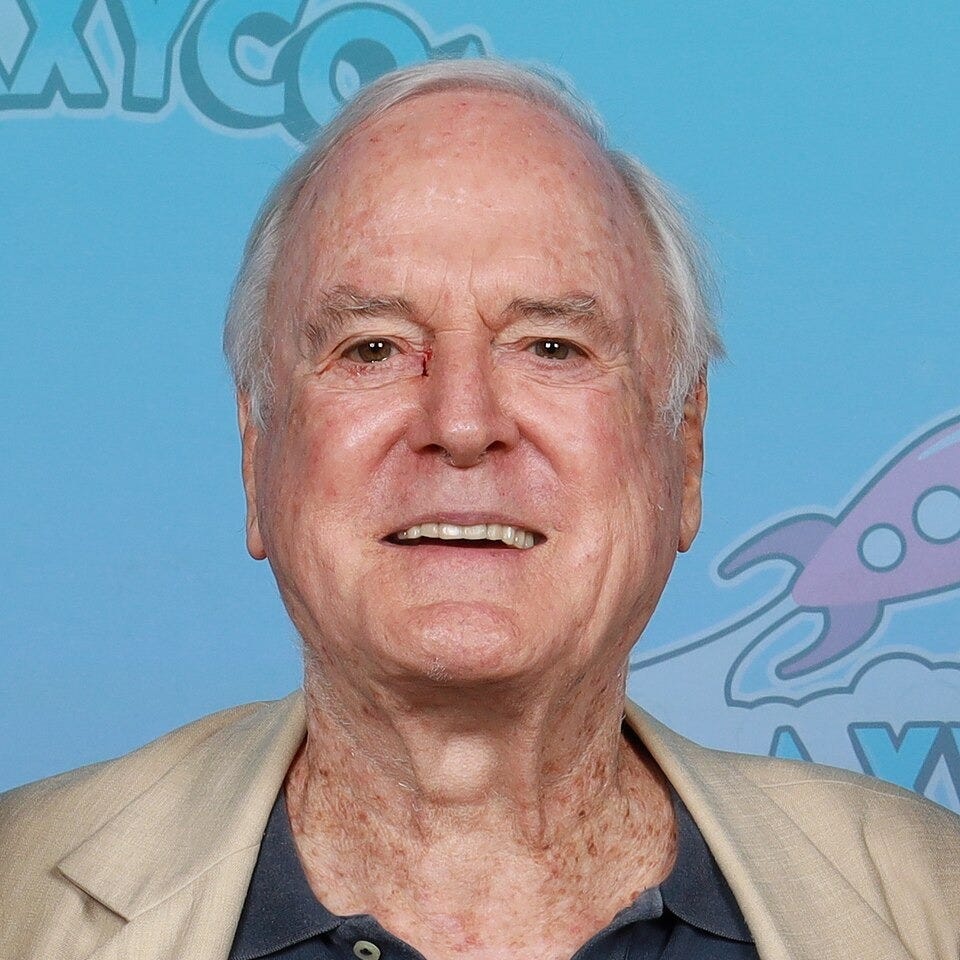
John Cleese is one of the very few celebrity activists I can get behind. Actually not “activist” – a word that now calls to mind trustafarians and murder junkies marching side by side through the world’s capitals for a recently deceased ayatollah.
Cleese is not an activist, then, but he is delightfully vocal and unfiltered on the absurdities of the moment. He’s become that rare thing in a stupid age – an influential voice of common sense in a world that treats such things as “problematic” and inflammatory.
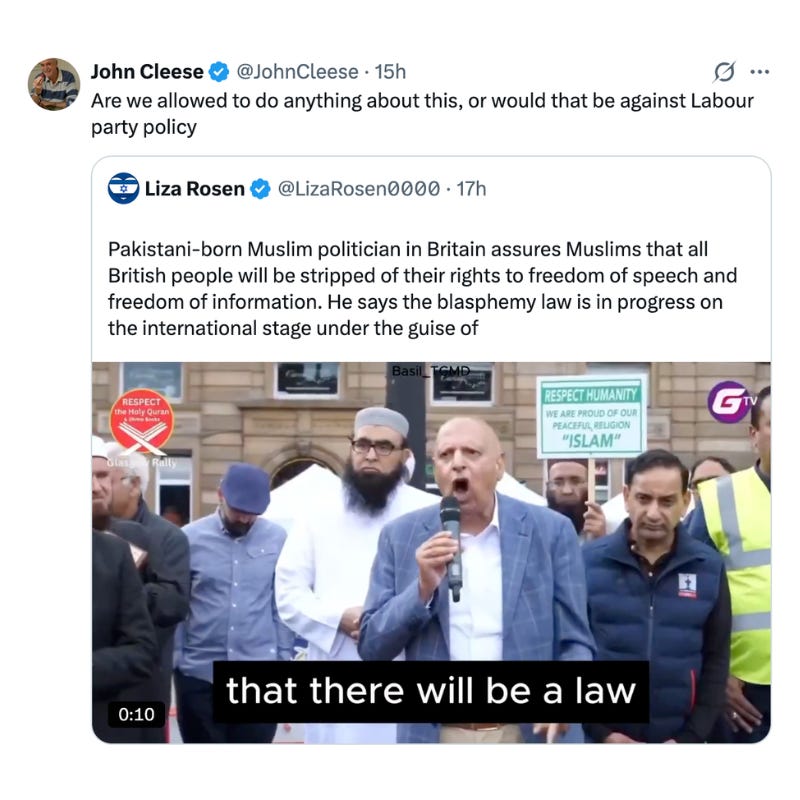
Evidence of this comes from his recent posts on X, which point to the UK's unutterably stupid descent into an intellectual suburb of Islamabad.
Here’s a taste of what he’s been saying:
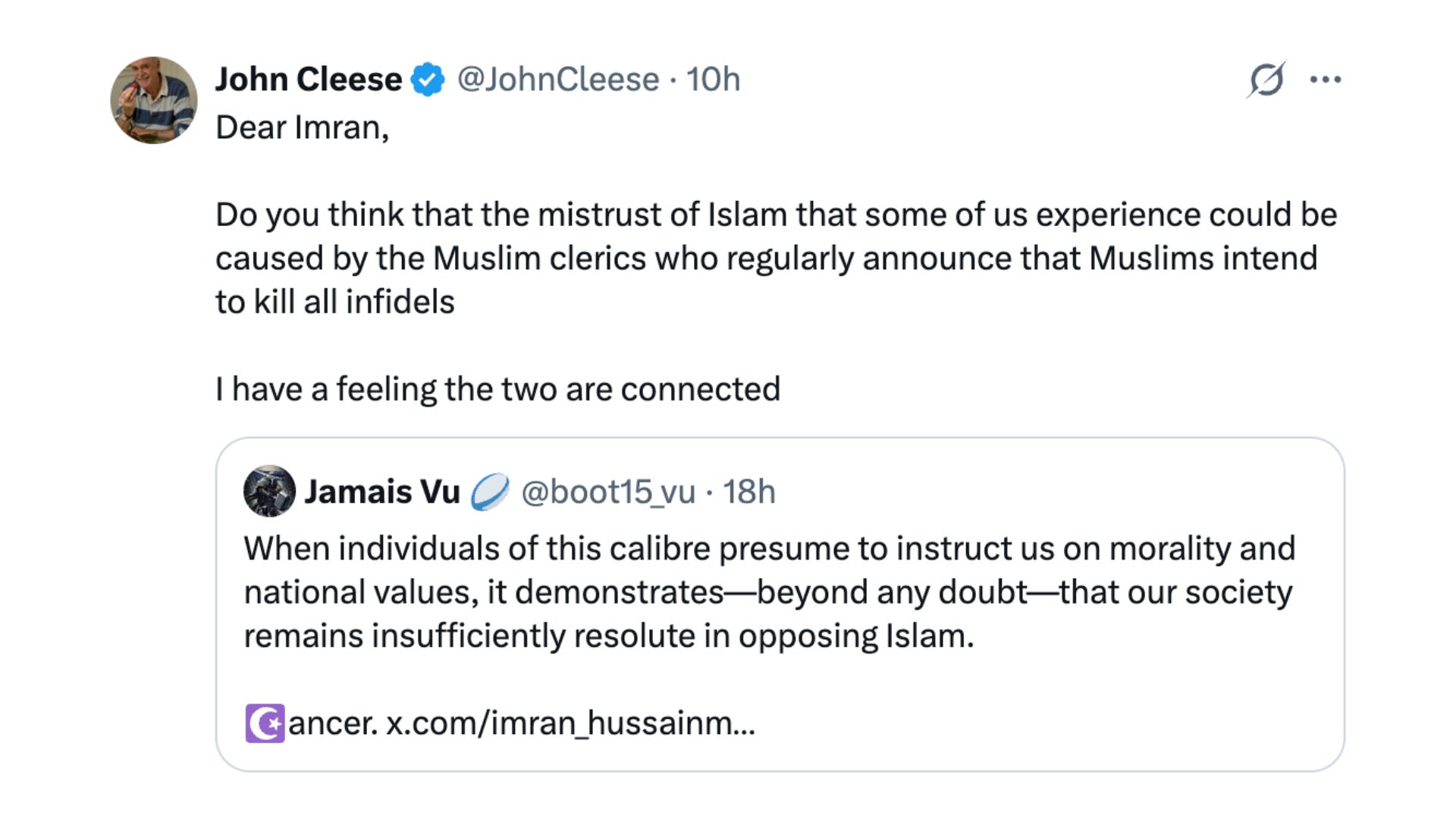
Cleese has probably retweeted things he shouldn’t. He’s 86 and posting in hurried disbelief at what’s happening to his country. The occasional loose cannonball is inevitable – and forgivable. I’d rather that than the bland, inoffensive slop that passes for conviction among people with more to lose and less to say.
If Cleese were just another retired octogenarian, I suspect someone from the Starmer Stasi would have knocked on his door by now. They haven’t and probably won’t because he has an enormous online presence, or “reach” as marketers say – and reach, in this climate, is the only reliable protection.
Protection from what? Protection from saying what so many people think but have learned not to say: that Great Britain has been shat upon by a spiteful, technocratic, ideologically bamboozled collection of characters who belong in a Monty Python sketch, not the UK Parliament. That sort of thing.
Cleese has nothing left to prove. This is the man who co-wrote The Life of Brian and gave us Basil Fawlty. A man who has gifted the world more laughter than all humourless ideologues could ever bury under an avalanche of sanctimony.
More importantly for this discussion, he’s at an age where he has nothing to lose. Freed from the social calculus that keeps younger celebrities rigidly aligned to progressive orthodoxies, he’s able to post freely about extremism and the institutional cowardice that refuses to name it.
The response from the cultural establishment has been predictable: he’s gone mad; best not to engage; old white man howls into the wind. The instinct, as always, is to pathologise common sense as some kind of cognitive defect. “Is John Cleese OK?” – that patronising little question that implies mental illness while pretending concern.
He’s more than OK. He’s enjoying a second burst of the same irreverence that made him famous – which makes sense, because the target is essentially the same. When The Life of Brian was released in 1979, it was widely banned and picketed by people who apparently couldn’t tell the difference between Jesus and Brian. Cleese and the other Pythons, then in their thirties, skewered precisely the sort of people who most needed skewering – the pious and the pompous. The sort of people who today tell you to “educate yourself” and call you a racist for noticing things, in the belief that this wins the argument rather than advertises the absence of one.
Cleese has been thinking about this problem for a long time. Years ago, he gave a wonderfully clear explanation of the mentality of fanaticism – the habit of dividing the world into the pure and the impure, the enlightened and the damned.
The fanatics have only multiplied since. Like a lot of truly great comedy, the clip hits the target long after the first shot is fired. This was from a time when comedy and satire had a job to do and did it well.
What a pity, then, that modern comedians are so tiresomely quick to share their moral positioning on climate, trans rights, and every other urgent “moral emergency”, yet remain silent on the actual evils in our society. Today, satire is almost dead, not because so much of what surrounds us is beyond parody, but because the reputational costs are too high and the rewards for toeing the line too compelling.
What are the odds that at next week’s Oscars anyone will show solidarity with the massacred dissidents of Iran or call out the grotesque apologists for theocratic fascism? We won’t hear a word. Instead, we can expect the usual ejaculations about Gaza, Trump’s threat to democracy, and the existential horror of border enforcement. The causes that cost nothing, aimed at the enemies that are safe to have.
Not Cleese, though. He hasn’t been stupefied by fame and in his later years is using it for something useful – stirring things up and being a nuisance, or a gadfly, as I like to think of it.
Not that I agree with him on everything – of course I don’t. Agreement is not the point. Intellectual honesty and the courage to speak plainly are.
There’s something both funny and faintly melancholy about all this. The satirical tradition he helped build was supposed to be self-renewing – each generation finding the next sacred cows and roasting them like before. Instead, we’re watching an octogenarian do the job that a younger generation has decided is too risky to pursue, preferring instead to bore us with sermons about diversity and inclusion. Who the hell watches a comedian for that?
Cleese has remained true to his vocation. By the standards of the current moment, that makes him a dissident. Which probably says rather more about the moment than it does about him.
If you want to take the pulse of a culture, start with its comedy. Ours, with a few exceptions, is very unwell

If you’ve noticed the emperor has no clothes, but everyone around you keeps complimenting his trousers, subscribe. There are more of us than you think.
Gadfly Quotes
I’ve added a new section to The Gadfly – a place for some of my favourite quotations, aphorisms, quips and epigrams. These are the sort of lines you can dip into when you’d rather hear from people who have thought more deeply about the big questions than most of us.
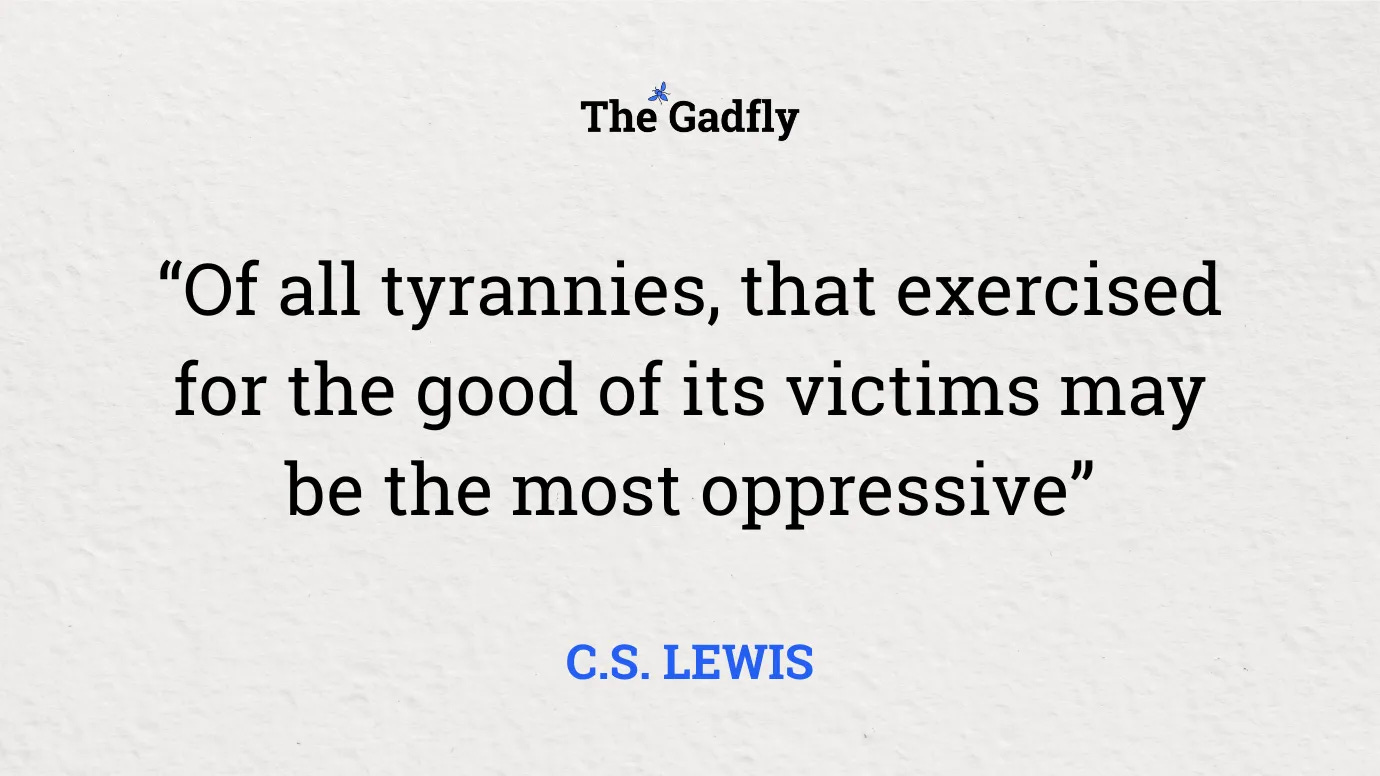
If you have a favourite of your own, add it in the comments of the post below. I’ll update these posts with the best ones as the collection grows. Over time, I hope to build up a small library worth dipping into.
Here’s the first one.

Survey
I’d love to know more about my readers and learn what you think about The Gadfly – what works, what you'd like more of, and so on.
This will take less than a minute – thanks! ⬇️
You might also like:


Speaking of Twitter/X, I think I'll need to be more active there to get a few more eyes on these articles. If you're on X, give me a follow and say hello. I'll follow back. And if you share this piece there (or any other piece), don't forget to tag me: @GadflyNotes
Oh, and don't forget the survey if you have a spare minute: https://www.gadflynotes.com/survey/5979065
Thanks!
I saw him speak at his book launch recently. It was sad to see him looking so frail but it’s brilliant that his mind is still on top form. Long may he continue to stir things up and do what comedians are supposed to do.
I don’t know if this counts as a quote but after October 7th Douglas Murray said” Every so often a flare goes up and you see exactly where everyone is”. It could be applied to many situations.
And I love Helen Staniland “Transactivism- a movement that fails to state what rights it’s fighting for on the grounds that it might incriminate itself”.
I’ve got more but that’ll do for now. 😁