How the BBC Became Orwell’s Nightmare
The institution Orwell fled has become the thing he warned us about.
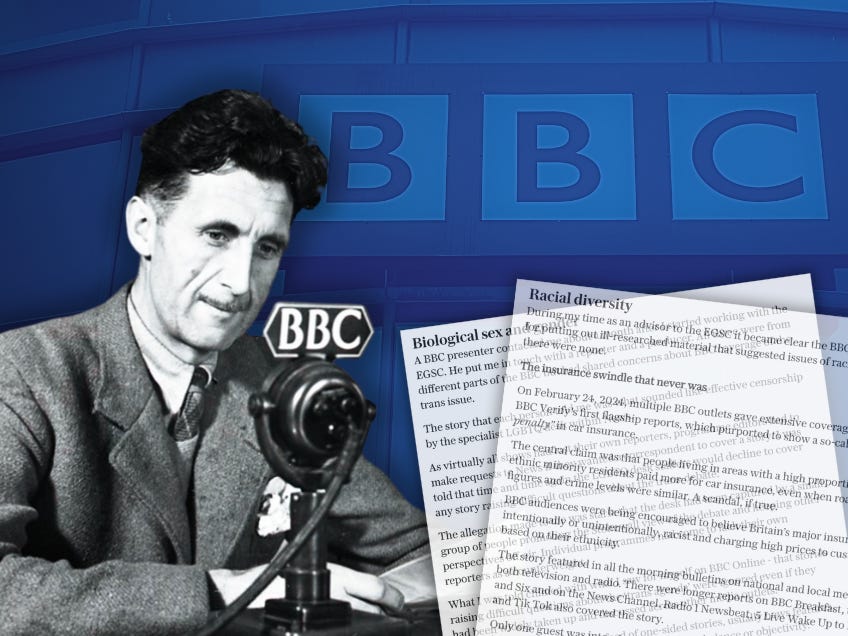
George Orwell worked at the BBC’s Eastern Service from 1941 to 1943, producing wartime propaganda broadcasts for the Indian subcontinent. He hated the bureaucracy and euphemisms, the way language bent around power. He left in 1943, disillusioned, and channelled the experience directly into Nineteen Eighty-Four, one of civilisation’s best guides to totalitarian thinking.
Orwell’s prescience is famous, of course. And while “Orwellian” has become a cliche in today’s political discourse, it aptly describes the strange fall of the BBC from a once universally admired institution to one warped by groupthink and ideological capture.
Orwell observed that institutions don’t usually distort reality out of malice, but out of certainty. Good people often persuade themselves that manipulation serves the truth, that narrative coherence overrides the obligation to report what actually happened.
In his essay Looking Back on the Spanish War, Orwell writes:
“I saw great battles reported where there had been no fighting, and complete silence where hundreds of men had been killed… and I saw newspapers in London retailing these lies and eager intellectuals building emotional superstructures over events that had never happened.”
Later in the same essay, he says:
“This kind of thing is frightening to me, because it often gives me the feeling that the very concept of objective truth is fading out of the world.”
Eighty years on, the BBC has become the thing Orwell feared.
The memo that plunged the BBC into crisis
This week, a devastating internal memo leaked to The Telegraph exposed systematic bias across BBC News. Written by Michael Prescott, a former adviser to the BBC’s Editorial Guidelines and Standards Committee, the 19-page dossier catalogues a pattern of institutional failures so severe that the BBC’s Director General Tim Davie resigned. Naturally, The Guardian is calling these events “a coordinated, politically motivated attack”.
The most explosive revelation concerned a Panorama documentary aired one week before last year’s US election. The programme spliced together clips from Donald Trump’s 6 January speech. The edit made it appear that Trump said: “We’re gonna walk down to the Capitol and I’ll be with you and we fight. We fight like hell.” In reality, the first part came 15 minutes into the speech and the second 54 minutes in. Between them, he had urged supporters to march “peacefully and patriotically.”
When Prescott raised this with senior executives, Jonathan Munro defended the edit: “There was no attempt to mislead the audience... It’s normal practice to edit speeches into short-form clips.”
But editing that materially alters meaning is something else entirely. Prescott’s point was simple: if BBC journalists are allowed to make people appear to say things they did not say, the whole claim to impartiality collapses.
Crucially, Prescott said this wasn’t a one-off but part of a broader pattern. He highlighted other areas where the same instincts showed up:
Gaza / mass graves: In April and June 2024 the BBC ran stories on graves at Al Nasser and Al Shifa that strongly implied Israeli forces had buried bodies before withdrawing. The source was the Hamas-controlled Gaza Civil Defence Agency. The internal review reminded executives that the BBC had itself earlier “topped its bulletins” with footage of Palestinians digging those very graves – yet later reporting forgot that context and suggested something more sinister. No explanation was given.
Race / data stories: The high-profile BBC Verify piece on an “ethnic penalty” in car insurance was broadcast widely despite being based on old and unsuitable data and implying discrimination without considering other causes. It was eventually taken down altogether – something Prescott notes is “very rare”.
Gender / trans coverage: An internal review of BBC reporting on trans issues found what it called “unintended editorial bias.” Stories critical of gender medicine, detransitioners, or women objecting to male bodies in female spaces were either not covered or were framed through the activist lens, while celebratory pieces ran freely.
Israel–Hamas / BBC Arabic: A five-month review comparing English output with BBC Arabic found the English site ran nineteen stories on the October 7 hostages, while BBC Arabic ran none. Critical stories about Israel were replicated in Arabic; stories showing Israeli suffering were not. One Arabic-language headline describing the murder of seven Israeli civilians in Jaffa called it a “military operation” and omitted the fact that one victim was a young mother killed shielding her baby. The service also gave repeated platforms to contributors with openly antisemitic social-media histories – one who had called for Jews to be burned “as Hitler did” appeared 244 times; another who described Jews as “devils” appeared 522 times. Both were introduced as “journalists”.
Each of these areas of concern was raised internally, investigated internally, then minimised or dismissed by the Executive. That, Prescott warned, had become a real systemic problem.
And you see the same cultural reflex in smaller, more human moments. When a BBC presenter rolls her eyes and corrects “pregnant people” to “women” – i.e. the correct, comprehensible term – and the institution’s response is to censure her, you’re no longer dealing with isolated editorial errors. You’re looking at a broadcaster that now treats reality as a breach of impartiality.
How institutional groupthink takes over
Practically all British institutions have followed a similar path, but the BBC is the case study that matters because here is an institution that declares impartiality as part of its mission:
“The Mission of the BBC is to act in the public interest, serving all audiences through the provision of impartial, high-quality and distinctive output and services which inform, educate and entertain.”
So what happened?
Like most British institutions, the BBC hires from universities where progressive assumptions dominate. It operates in metropolitan circles where those assumptions go unchallenged. Anyone holding a dissenting view is marked as strange – not wrong, but off – as though conflicting views suggest cognitive and moral failure. In such an environment, success depends largely on cultural fit. Eventually, your worldview stops being a perspective you hold and becomes the lens through which you see reality.
At this point, institutional bias becomes indistinguishable from clear sight. “The very concept of objective truth is fading out of the world,” Orwell said, and it begins when the institution mistakes its own moral certainty for objectivity. That’s why something as ordinary as saying “women” instead of “pregnant people” is treated as deviant. The language of an internal culture has replaced the language of the public.
You can’t reform an institution that treats its own assumptions as reality. The BBC monoculture that produces this has become its operating system. In six months, something identical will happen because the system generating these failures remains intact.
The misalignment between the BBC and the licence-fee payers who fund it is stark. This is a difference in foundational assumptions. The vast majority of the public thinks borders matter, biological sex is real, and merit counts more than identity. In the corridors of the BBC, such statements are treated as heresy.
And so we have a corporation that serves an audience whose values it can’t comprehend, funded by people it disdains.
The BBC is just the most well-known example, and the pattern repeats across virtually every major institution, from the Civil Service to the NHS and every major charity. These are closed epistemic systems generating “truths” that begin with ideology and reengineer reality to fit.
The memory hole
Orwell’s warning wasn’t just about totalitarian states. It was about the human capacity for self-deception when sealed inside consensus. During his time at the BBC, he made propaganda for a just cause in wartime. The BBC that exists today makes propaganda for a progressive consensus in peacetime.
The difference now is that the BBC doesn’t need crude coercion, nor is it fighting genuine fascism. Instead, it operates in buildings full of intelligent people who simply cannot see what they’re doing.
That’s frightening, not just because truth is being cast down the memory hole, but because those doing it believe, utterly, that they are right.
You might also like:


Outstanding. "A corporation that serves an audience whose values it can’t comprehend, funded by people it disdains". Exactly.
Great article, well written and absolutely spot on!